Chronology
1795
May 19:
Johns Hopkins is born at Whitehall, his
family's tobacco plantation, in Anne Arundel County,
Maryland.
1867
August 24: Johns Hopkins incorporates both his
university and his hospital.
1868
Peabody Academy of Music opens under the direction of
Lucien H. Southard with 148 students. In 1857 George
Peabody had proposed the establishment of an institute in
Baltimore to be comprised of a library, art gallery,
academy of music, and a lecture series. Peabody had
attended the dedication of the institute's first building
on October 25, 1866, and had declared, "I never experienced
from the citizens of Baltimore anything but kindness,
hospitality and confidence." Building had been completed in
1861, but the Civil War had intervened.
1870
June 13: First meeting of the trustees for the
university and hospital under the charters of 1867.
Galloway Cheston, Baltimore financier and philanthropist
and one of the original trustees of the
Peabody
Institute, is elected president of the university's
board of trustees.
1873
March 10: In his letter to the trustees of The Johns
Hopkins Hospital setting forth the principles they are to
follow, Hopkins states that the hospital must provide for
"The indigent sick of this city and its environs, without
regard to sex, age, or color, who may require surgical or
medical treatment, and who can be received into the
Hospital without peril to other inmates." Letter also
directs that the hospital should accommodate four hundred
patients, and that a school of nursing and a school of
medicine should be established in conjunction with the
hospital.
December 24: Johns Hopkins dies at his residence at
81 Saratoga Street in Baltimore at the age of 78. The
funeral, conducted according to the form of the Society of
Friends of which Mr. Hopkins was a member, is held December
26 from his home; he is buried in Greenmount Cemetery.
(Read The Baltimore Sun
obituary.)
The Baltimore Sun estimates his estate at $8
million,
including $2.25 million in stock of the Baltimore & Ohio
Railroad Company and $1 million in bank stock. In an
editorial, the Sun compares Hopkins' gift of the
proposed university and hospital to those of George Peabody
and Moses Sheppard and says of Hopkins, "It is gratifying
to see a man who had thus successfully labored turning his
attention ere life's close to great schemes of beneficence,
by which an undoubted good is to result which cannot be
interred with his bones. The good which such men do lives
after them, blossoming and bearing fruit for the
improvement and happiness of future generations."
1874
Peabody Academy of Music becomes the Peabody Conservatory
of Music.
October: University trustees write to Daniel Coit
Gilman, president of the University of California in
Berkeley, requesting that he consider the presidency of
Johns Hopkins. Gilman travels to Baltimore and meets with
trustees on December 29 and tells them that he would create
a major university devoted to research and scholarship.
Trustees elect him president the following day.
1875
President Gilman begins his term as first president of
The Johns Hopkins University.
[Read Gilman's
inaugual address online.]
1876
February 12: At the annual meeting of the board of
trustees of Peabody Institute, Judge George Brown makes the
motion, which the trustees adopt, that "In view of the
establishment of The Johns Hopkins University in our
community, and of the wide field thus opened for the
advancement of the intellectual & moral welfare of our
people; and, desiring to establish, at the earliest date,
affiliation with it in promoting the educational interests
of the State: Resolved, That the Board of Trustees of The
Peabody Institute convey to the President & Trustees of The
Johns Hopkins University this expression of interest & good
will; suggesting that this Institute being, within its
scope, an educational element of the State, should be in
sympathy with the university, and by interchanges of
courtesy, and cooperation, assist in its high educational
aims."
February 22: Daniel Coit Gilman is inaugurated as
first president of The Johns Hopkins University during
ceremonies at the Peabody Institute where the Peabody
Orchestra performs. An editorial in the Gazette
proclaims, "We consider this one of the most important
events in the recent history of the city. Baltimore, which
has so often been reproached as a big provincial town, is
about to become the seat of a great university -- a city
set on a hill, a center of light."
September 12: Thomas Huxley delivers the
university's opening address and sparks controversy among
those who see his writing as subversive of religious
faith.
October 4: First lecture at the new university given
this day at 5 p.m. by Professor Basil Gildersleeve on
Greek
lyric poetry. Classes for students begin the next day. The
faculty is composed of Gildersleeve (classics), James J.
Sylvester (mathematics), Ira Remsen (chemistry), Henry A.
Rowland (physics), and Henry Newell Martin (biology).
[Learn more about
Basil Gildersleeve online.]
1878
Professor James J. Sylvester edits the first issue of the
American Journal of Mathematics, and it is published
"under the auspices of" the Publication Agency of The Johns
Hopkins University. The New York Times says, "Johns
Hopkins University ought to become the highest court of
appeal in theoretical science and philosophy. Looking to
occupy a position of this kind, it is very appropriate that
so important a step as the foundation of a journal of pure
and applied mathematics should be taken by the Baltimore
university." [Learn more about
James Sylvester online.]
Summer. Dr. William K. Brooks of the biology
department opens a laboratory on the Chesapeake Bay, the
first undertaking of its kind by a university and the first
such laboratory south of New England. By 1880 The Johns
Hopkins University Marine Zoological Laboratory has moved
to Beaufort, North Carolina.
September 30: Peabody Library occupies a new
building designed by Edmund G. Lind, who also designed the
original building. The central well is sixty-one feet high,
with six levels of stacks supported by cast-iron pillars.
Fifteen percent of the library's holdings are not
duplicated in the Library of Congress.
1879
Professor Ira Remsen edits the first issue of the
American Chemical Journal, which is published by the
publication agency. [Learn more about
Ira Remsen online.]
June: George W. McCreary, A. Chase Palmer, and
Edward H. Spieker receive bachelor of arts degrees as the
first graduates of The Johns Hopkins University.
1880
Basil L. Gildersleeve edits the first issue of the
American Journal of Philology, which is published by
the publication agency.
1881
April 22: Alexander Graham Bell lectures to a large
audience in Hopkins Hall on his experiments with the
transmission of sound by using rays of light instead of
wires.
1882
June 3: First Peabody graduates receive their
diplomas.
December: Herbert B. Adams, associate professor in
history, edits Studies in Historical and Political
Science, the first monograph series published by The
Johns Hopkins University Publication Agency.
1883
January 30: In an address before the YMCA of
Baltimore, John Work Garrett criticizes his fellow trustees
for spending "enormous sums in the City of Baltimore and
not at Clifton Park," Johns Hopkins' country estate where
both men had expected the university to locate. Clifton is
gradually whittled away by condemnation: in 1879 for a
reservoir, in 1892 for a railroad right-of-way, and finally
the remainder of the estate in 1895 for a public park. A
close friend, neighbor, and colleague of Johns Hopkins, Mr.
Garrett also takes issue on several occasions with the
emphasis on graduate study and research which, he implies,
prevents the university from doing much for the young men
of the region, whom Mr. Hopkins had wanted to aid.
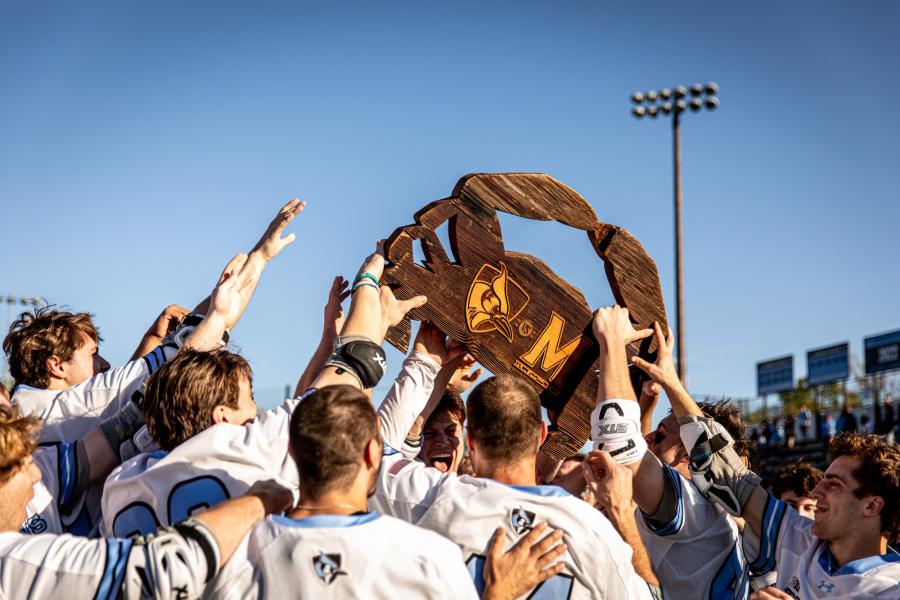
May 1: Druids Club of Baltimore defeats the newly
formed Johns Hopkins lacrosse club 4-0. This is the last
official game until 1888, when Hopkins enjoys its first
win, a 6-2 victory over the Patterson Club. From 1888
Hopkins teams play every season except 1944, when athletics
are curtailed by World War II.
December 3: The American notes, "Whenever
there is a lecture at Johns Hopkins University upon a
plain, everyday topic of practical importance, the audience
consists almost exclusively of men; but when a speaker gets
up to talk about abstruse psychological subjects, such as
are discussed by Mr. Stanley Hall, there is always a large
number of ladies present. The same singularity is noticed
at the Peabody lectures when profound themes are
elucidated."
1884
The Johns Hopkins Glee Club gives its first concert.
Woodrow Wilson sings first tenor. Wilson receives his Ph.D.
in 1886; in 1913 he becomes the only U.S. president to hold
an earned doctorate.
1885
May 4: University trustees adopt the official seal
presented by Stephen Tucker of London. Tucker describes the
seal as presenting "an heraldic picture of a University
situated in the State founded by Lord Baltimore." The seal
carries the motto "Veritas vos Liberabit" (John 8:32) and
the legend "The Johns Hopkins University: Baltimore:
1876."
1886
Proficiency in Applied Electricity course to train students
for engineering positions opens under the leadership of
Louis Duncan. The course had been requested by local
industry, especially the Baltimore & Ohio Railroad. The
program is offered within the department of physics led by
Henry A. Rowland, under whom Duncan had obtained his Ph.D.
Duncan tells President Gilman that he sees the course as
teaching "electricity as a science and in its practical
application." Course runs for thirteen years and certifies
ninety-one students, almost all of whom become practicing
electrical engineers.
April 26: A resolution is offered for formation of
an
alumni association at the observance of the tenth
anniversary of the university at Mount Vernon Place
Methodist Church.
1887
Kelly Miller, the first African-American student to enroll
at Johns Hopkins University, begins his studies for a
graduate degree in mathematics with the encouragement of
Simon Newcomb, professor of mathematics. Miller is obliged
to leave two years later when the university's economic
crisis prompts a twenty- five percent increase in tuition.
Some years later, Newcomb and President Gilman recommend
Miller for a faculty position at Howard University, his
undergraduate alma mater, where he serves for many years as
professor of mathematics and dean of arts and sciences.
1888
April 10: Hospital board learns that the
hospital is completely finished inside and out
except for the gas fixtures.
November 13: Daniel Coit Gilman and the Reverend J.
F. Goucher give addresses at the opening ceremonies for the
Woman's College of Baltimore. The Sun deems it "one
of the most comprehensive of its kind in the world, and a
fit companion for the Johns Hopkins University."
1889
May 7: About six hundred people attend ceremonies
formally opening
The Johns Hopkins Hospital. Mrs. Daniel
Coit Gilman, writing to her daughters, describes the
occasion: "Of course the great event of the week has been
the opening of the hospital. The day was superb and all the
buildings in apple pie order; grounds ditto. The exercises
were in the administration building and a band of twenty-
five instruments was in the third gallery. There was plenty
of bunting and flowering plants and ladies in their gay
dresses and it was a very pretty scene. Mr. Francis King
made an excellent little address and Dr. Billings a very
sensible one and Papa touched the popular heart as usual. I
think all the speeches struck a very high note. There was
no self-glorification, no mere spread eagle and empty
oratory but a tone of earnest responsibility in the
presence of a great trust. I think everyone must have been
struck with it."
September: Failure of Baltimore & Ohio Railroad
stock creates a crisis in the university's finances.
Professors accept reduced salaries and fees are increased.
President Gilman says 1889-90 school year will begin as
usual.
October 9: The Johns Hopkins Hospital's
School of
Nursing formally opens. Miss Isabel Hampton, first
superintendent of nurses, speaks on the role, training,
restrictions, and duties of nursing. The next day, an
editorial in the American says the training school
for nurses "is destined to be in the coming years scarcely
less important and useful than the development of the more
imposing science of medicine and surgery, of which it is
rapidly growing to be the twin companion. Without careful
nursing, medicine and surgery are crippled agencies in the
preservation of health and life, and with careful nursing
it is often possible to preserve both without their
assistance."
1890
March: Eight thousand books bequeathed to Johns
Hopkins University by John W. McCoy are being readied for
use. Collection concentrates on illustrated folios of
geography and topography and engraved reproductions of the
fine arts. Mr. McCoy, a Baltimore businessman, left his
pictures and statues to the Peabody Institute.
April 13: The New York World runs an article
with the headlines: "Sober Johns Hopkins. It is a
university of manly young men. Dudes are seldom found
there." The text continues, "Johns Hopkins University
is a steady-going place, containing few dudes and no
students who lead the sumptuous lives that characterize the
Harvard men. The classes are made up largely of manly
fellows who mean business and who have little time to
devote to college frivolity."
May 2: Five Baltimore women organize the Women's
Fund Committee. M. Carey Thomas, Mary Elizabeth Garrett,
Mary Gwinn, Elizabeth King, and Julia Rogers intend to
raise money needed to establish the School of Medicine with
the condition that the school will accept women with the
same high qualifications as male applicants. Women in
Boston, Philadelphia, Washington, New York, Chicago, San
Francisco, and other cities join with Baltimore women.
November 25: Professor William K. Brooks warns that
unless oysters are planted, they will die out.
1891
The Johns Hopkins University
lacrosse team wins its first
national title in the Intercollegiate League, followed by
championships in 1898, 1899, and 1900; Hopkins then
withdraws from the league to become a charter member of the
Intercollegiate Lacrosse Association.
The Publication Agency of The Johns Hopkins University
becomes The
Johns
Hopkins University Press and remains
under the direction of Nicholas Murray who is also
librarian of the university.
June 5: Dr. William Osler, physician-in-chief of
the hospital, addresses the first class to graduate from
The Johns Hopkins Hospital's School of Nursing and tells
the new alumnae, "Practically, there should be for each of
you a busy, useful, and happy life; more you cannot expect;
a greater blessing the world cannot bestow. Busy you will
certainly be, as the demand is great, both in private and
public, for women with your training. Useful your lives
must be, as you will care for those who cannot care for
themselves, and who need about them, in the day of
tribulation, gentle hands and tender hearts. And happy
lives shall be yours, because busy and useful; having been
initiated into the great secret -- that happiness lies in
the absorption in some vocation which satisfies the soul;
that we are here to add what we can to, not to get
what we can from, life."
May 15: Peter Ilich Tchaikovsky performs at the
Peabody Conservatory of Music. October 1: Classes begin for
the university's sixteenth year. Two days later, the
Baltimore American reports that Miss Florence
Bascom, daughter of the ex-president of University of
Wisconsin, will "take part" in the geological department,
"giving special attention to the course in geography
conducted by Professor Williams." Bascom's admission will
not be as a "member proper" of the university; she will not
pay tuition; she will not appear on the roster of students.
Johns Hopkins sometimes allows this if no like instruction
is offered at women's schools. Thus, Bascom's admission
"marks no change in the general attitude of the university
towards the admission of women to its courses."
December 16: McCoy Hall, a new academic building, is
being planned by architects. To make room for the new
structure, Levering Hall will have to be moved by
jackscrews westward to Eutaw Street. The following July the
trustees agree to the design and award a contract. Move of
Levering Hall begins the week of the August 12.
1892
March 15: Dr. Henry Hurd recommends that a separate
ward for colored patients be built and the hospital
trustees vote that his motion be referred to the executive
and building committees. The American reports that
the building will be erected to the east of the isolation
ward on the east end of the hospital. It will have a center
wing of three stories and north and south ward wings of two
stories, with accommodations for fifty-six patients, men on
first floor, women on second. Nurses will occupy the third
floor of center wing. "Special care will be taken to see
that the heating and ventilation apparatus is as perfect as
possible. A sun balcony will be erected on each floor on
the east side, for convalescents, while a sun bay-window
will be constructed at the south end of the south wing. On
each floor there will be a dining room, kitchen, lavatory
and bath-rooms. . . .The building will be fireproof
throughout."
November 1: National Academy of Sciences meets this
week at physical laboratory of Johns Hopkins University.
Hopkins professors Rowland, Remsen, Brooks, and Williams
present half of the papers at the meeting. Public
attendance in Baltimore is unprecedented.
December 22: Mary Elizabeth Garrett announces that
she will give more than three hundred thousand dollars so
that the Women's Fund Committee can meet its goal to open
the medical school. Garrett stipulates that not more than
fifty thousand dollars may be spent on buildings, and the
main building shall be known as the Women's Fund Memorial
Building and that the school must be a four-year graduate
school for men and women who are to be admitted without
distinction between them. She also requires the creation of
a committee of six women "to whom the women studying in the
medical school may apply for advice concerning lodging and
other practical matters, and that all questions concerning
the personal character of women applying for admission to
the school and all non-academic questions of discipline
affecting the women studying in the medical school shall be
referred to this committee, and by them be in writing
reported for action to the authorities of the university."
University trustees accept Garrett's gift and her
conditions on December 24. An editorial statement in the
Sun says, "The women of the country are to be
congratulated upon finding so generous a champion as Miss
Garrett has proved to be, and the university has no less
cause to be congratulated. All will wish for the success of
this important step toward the education of women in a
profession where equal opportunities with men have been so
long denied them." [Learn more about
Mary Elizabeth Garrett, founding benefactor of
the School of Medicine, online.]
1893
1893: Harry Fielding Reid names a
glacier in Alaska after his alma mater,
The Johns Hopkins University, where he earned both a
bachelor's degree and a Ph.D. in physics. Johns
Hopkins Glacier is located in Glacier Bay National Park.
June 13: Florence Bascom becomes Johns Hopkins
University's first female Ph.D. The American notes
that Miss Bascom is "very modest" and did not attend
ceremonies to receive her diploma.
October 2: Dr. William Welch, professor of pathology
in the university and the hospital's pathologist, reviews
the credentials of sixteen applicants to the
School of Medicine, five of whom are graduates of Johns
Hopkins
University. All of the applicants, including three women,
are admitted and classes begin.
1894
Sisters Marian and May Garrettson Evans open the first
music school for Baltimore children, the forerunner of the
Peabody Preparatory School.
October 8: About a thousand people inspect the new
McCoy Hall, which is lighted by electricity. The building
also features two large electric elevators, said to be the
first in Baltimore. Classrooms, offices, and lecture rooms
are on the second and third floors, and a library with
thirty thousand volumes is on the fourth.
1895
October 11: President Gilman meets with students to
talk football and rouse interest in the sport. The
Sun reports that Baltimore businessman Edgar Allan
Poe, former coach of the Princeton team and of at least one
disastrous Johns Hopkins team, chides, "You must keep
abreast of the other colleges. Football is today
recognized as the typical college sport, the national
college game. And you ought to be ashamed to have it said
that such a great university as this is has no team to
represent it." Poe contends that "nothing develops a man's
character more, quickens and makes more perfect his self-
reliance, makes him think quickly and act promptly,
develops his muscles, his brain, his courage, his courtesy.
It is the safest and most legitimate outlet for animal
spirits among young men."
December 19: Professors and graduate students who
have been members of chapters in other colleges organize
the Johns Hopkins University chapter of Phi Beta Kappa
Society. The Hopkins chapter is to be called Alpha of
Maryland. Daniel Coit Gilman is elected chapter president
and eighty-six men who have received bachelor's degrees
from Johns Hopkins (of more than four hundred total) are
selected for alumni membership.
1896
May 20: William Bullock Clark, professor of organic
geology who is also the state geologist, sails with six
scientists for the Eastern Shore on an oyster navy boat.
They will do preliminary work on state geological
survey.
October 14: Statue of Christus Consolator,
the gift of William Wallace Spence of Baltimore, is
unveiled in the rotunda of hospital by Emily Riggs, four-
year-old great-granddaughter of the donor. The figure is a
copy of a statue created by Danish sculptor Bertel
Thorswaldsen.
1897
June 15: First class graduates from Johns Hopkins
University School of Medicine. The fifteen graduates
include Mary Packard of Bayonne, New Jersey, one of the
three women who had entered with the class.
James M. Thompson and Edgeworth Smith found the
News-Letter to give undergraduates news on campus.
Trustees had initially opposed the idea of a campus paper,
but eventually allow four issues to be published at the end
of the 1896-97 school year. Trustees give formal approval
the following year. Paper is printed every two weeks of the
school year for the first twelve years, and is largely
literary in character with articles written by both faculty
and students. In 1909 News-Letter becomes a six-page
weekly newspaper. (Visit the
News-Letter online.)
1898
November 4: A course of lectures in history
especially for teachers in the Baltimore public and private
schools begins at 8 p.m. The next morning a scientific
course for teachers begins in the geological lecture room
of Hopkins Hall. Each course will have twenty lectures.
1899
March 22: Members of an expedition from the medical
school meet in Chicago to begin a journey around the world.
They will go to Hong Kong, and Japan, and set up
headquarters in Manila to study tropical diseases.
June 2: More than one hundred alumni, faculty, and
graduate students join the new Johns Hopkins Club.
(Visit the
Johns Hopkins Club online. )
1901
February 5: Local newspapers announce the proposed
gift of 151.75 acres of land on Charles Street as a new
site for The Johns Hopkins University. Donors William Wyman
and William Keyser stipulate that $1 million in endowment
must be raised.
June 11: Daniel Coit Gilman gives his farewell
address as president of Johns Hopkins. Gilman congratulates
the university on the selection of
Ira Remsen as its next
president.
1902
February 22 and 23: Johns Hopkins University
belatedly celebrates its twenty-fifth anniversary and
inaugurates its second president. Woodrow Wilson of
Princeton University presents Daniel Coit Gilman with a
testimonial gift from the alumni that contains the
signatures of more than a thousand graduates. The Peabody
Orchestra plays the processional.
November 6: Frederick Law Olmstead Jr. views grounds
of the future Homewood campus with President Ira Remsen.
1903
Henry Phipps, an iron and steel magnate, donates ten
thousand dollars for the establishment of a tuberculosis
clinic at The Johns Hopkins Hospital.
Dr. and Mrs. Christian Archibald Herter of New York give
twenty-five thousand dollars to found a memorial
lectureship in the medical department "designed to promote
a more intimate knowledge of the researches of foreign
investigators in the realm of medical science." First
lecture at the opening of the 1903-1904 academic year is
given by Dr. Herter himself on the "Influence of Pasteur on
Medical Science." Forty years later, Dr. Herter's nephew
became one of the founders of the
School of Advanced
International Studies.
1904
February 7: Hospital loses seventy properties, most
of them warehouses, in the great Baltimore fire. The
buildings had yielded one-half of hospital's annual
endowment income that helped fund its free dispensary. This
work is now threatened. The university does not hold its
regular Commemoration Day exercises on February 22 because
of the fire's enormous impact on the city. In May the
hospital receives a letter from John D. Rockefeller Jr. "In
view of the high character of work which the hospital and
medical school are doing in medical instruction and
research, including the training of nurses, which work he
understands will otherwise be materially curtailed because
of the losses, my father will give five hundred thousand
dollars to Johns Hopkins Hospital."
February 17: Poet William Butler Yeats visits Johns
Hopkins University and lectures the English seminary on
drama.
October 4: A portrait of Mary Elizabeth Garrett
painted by John Singer Sargent of London is unveiled in the
rotunda of the hospital and will remain there for several
days for inspection by the public before being given a
prominent place in the institution.
October 5: Dr. William S. Halsted performs the first
operation in the new surgical amphitheater. A team of
residents handpicked by Halsted to assist him includes
Joseph Bloodgood, Richard H. Follis, James Mitchell, Harvey
W. Cushing, Hugh H. Young, and J. M. T. Finney.
1905
February 22: Dr. William Osler delivers a farewell
address at Commemoration Day celebration before leaving for
England to become regius professor of medicine at Oxford
University.
May 17: The Baltimore News describes "New
Wyman's Park" in "North Baltimore," which has not yet
formally opened. The park is nearly a mile long, but
narrow, located along east bank of Stony Run from
Merryman's Lane to 29th Street, with frontage on Charles
Street for one block. The park circles around to rear of
proposed site of The Johns Hopkins University. "It is a
very rough and heavily wooded territory" famous for
chestnut expeditions. The park board is building drive that
will emphasize the land's natural beauty.
June: Pathologist William H. Welch, surgeon William
S. Halsted, and gynecologist Howard A. Kelly of the
original medical faculty at Johns Hopkins University meet
their former colleague William Osler in London and sit for
a portrait by John Singer Sargent. Mary Elizabeth Garrett
will bear the expense of the painting.
June 5: Florence Sabin is promoted to associate
professor of anatomy. The following week the Baltimore
News comments that "The appointment of a woman to a
position of this rank in an institution of such distinction
as the Johns Hopkins Medical School, and other than a
college for women, is without parallel among American
universities, in the Eastern section of the country at
least." Dr. Sabin received her medical degree from Johns
Hopkins University in 1900; in 1917 Sabin becomes the first
woman at Johns Hopkins to be appointed to a full
professorship.
1906
April: Professor Henry A. Rowland's multiplex
telegraph is used by the Italian government to transmit
messages from Naples during eruptions of Mount Vesuvius.
For a time, these are the only telegraphic messages to get
through. [Learn more about
Henry Rowland online.]
May: John Singer Sargent's The
Four Doctors
is the centerpiece at a private showing before the opening
of the 138th exhibition of the Royal Academy. The New York
Sun reports that the painting is considered to be
"the noblest work of art that has been hung in the Royal
Academy since Sir Joshua Reynolds was president of it, and
the most important and impressive of its type that has been
painted by any man since the seventeenth century drew its
curtain across the art of Holland."
May: University trustees approve a four-year
undergraduate plan, although a bachelor's degree can still
be secured in three years. Sub-freshman class will become
freshmen and regular freshmen to become sophomores. Twenty
courses are required for graduation.
1907
January 19: The Four Doctors is unveiled in
McCoy Hall.
April 9: Registrar Thomas Ball announces that women
"who have taken a baccalaureate degree at any institution
of good standing" may be eligible to be admitted to
graduate school at Johns Hopkins University. President
Remsen observes "It was simply a matter of justice -- I
should say of justice and common sense." The News
notes that, previously, there have been "other special
students from time to time."
May 28: New athletic field is finished at Homewood
and stands for spectators are being constructed. All should
be ready by October for football games. Medical students
are not expected to compete any longer since Homewood Field
is so far from the hospital.
1908
Johns Hopkins University lacrosse club plays its first game
on Homewood Field under coach William C. "Father Bill"
Schmeisser, and shares the national championship with
Harvard.
May: University trustees approve a master of arts
degree that will be granted when a Ph.D. is impossible or
unnecessary. The M.A. degree is especially suited to public
school teachers.
June: A generous gift from philanthropist Henry
Phipps permits the hospital to establish America's first
clinic for the treatment of mental illness and endows a
professorship of psychiatry at the university. September
17: Fire damages McCoy Hall. Sargent's portrait of The
Four Doctors is protected when newspapers are rolled up
and placed behind it to keep it away from the wall.
October 9: Botany professor Duncan S. Johnson
announces that regular work of his department will move to
the Homewood campus since the new botanical gardens and
greenhouse are ready.
October 13: Daniel Coit Gilman dies at the home of
his sister in Norwich, Connecticut.
1909
June: President Remsen announces that the university
will offer college courses for male and female teachers at
public and private schools in cooperation with the Woman's
College of Baltimore. Classes will start in October and
continue to June. They will allow teachers to continue
their professional duties and still attend classes.
November 20: Johns Hopkins University beats St.
John's College 18 to 0 in the first
football game between
the traditional rivals at Homewood Field.
1910
April: Campaign to raise $2 million to to build
necessary buildings and move the university to Homewood is
announced.
The Carnegie Foundation issues a report on education by
Abraham Flexner that singles out Johns Hopkins as a leader
in medical education. Five years later, Flexner notes that
Hopkins, "fortunate in its freedom from all entanglements,
in its possession of an excellent endowed hospital, and,
above all, in wise and devoted leadership, set a new and
stimulating example precisely when a demonstration of the
right type was most urgently needed."
1911
February 22: University board of trustees president
R. Brent Keyser announces that construction will begin next
summer on Homewood campus with the building of a hall
dedicated to the memory of Daniel Coit Gilman.
May 8: Newspapers announce that faculty at the
medical school will no longer be allowed to have private
medical and surgical practices and must devote all their
time to research and teaching. The change will severely
restrict the income of popular physicians and the
university is proposing to pay larger salaries.
June 13: So many degrees are awarded that
recipients no longer fit onto the stage of the Academy of
Music. Four women have earned Ph.D.s, six M.D.s, and three
M.A.s. The next day, the Evening Sun remarks that
"Many people are waking up to the fact that the Johns
Hopkins is a coeducational institution, and announcing
their discovery to their friends in accents of
amazement."
July: Peabody Conservatory initiates a summer
program in cooperation with Johns Hopkins University. The
university also offers summer school for teachers of both
sexes. Students have access to all the resources of the
university. Classes include social hygiene, physics,
education, English, German, manual training, chemistry,
domestic science, biology, mathematics, Latin, French, and
history.
1912
April 4: Governor of Maryland signs a law to fund "a
school or department of applied science and advanced
technology" at The Johns Hopkins University, establish
scholarships, and give Hopkins enough money to build at
Homewood. The law authorizes a bond issue of six hundred
thousand dollars to construct buildings and provide
equipment, and to furnish fifty thousand dollars per year
for maintenance. Hopkins is to give 129 scholarships of
free tuition to "worthy men of this State" to the school of
advanced technology or "courses preparatory thereto." The
following month, the trustees agree to the state's
conditions. In 1913 the school enrolls its first students,
including Abel Wolman, (although a number of students are
admitted the previous fall to take mathematics and physics
courses preliminary to their engineering studies). First
undergraduate engineering degrees are awarded in 1915. The
department becomes the
School of Engineering, with John
Boswell Whitehead as its dean, in 1919.
Second summer school at Johns Hopkins again includes a
session in conjunction with the Peabody. Musical
performances at Peabody are interspersed with lectures at
the university.
September: Announcement is made that a new building
named for Charles L. Marburg (whose heirs had given one
hundred thousand dollars in 1907) will be constructed for
the use of private patients.
October 14: The Sun reports that Dean J.
Whitridge Williams says that number of medical students
will be limited so that facilities will not become
overcrowded. This year there are 355 medical students;
almost fifty applicants have been turned away. Williams
says that a limit on the number of students is "essential
to the preservation of high ideals and of proper methods of
teaching and that further expansion cannot be expected
until those interested in the advancement of medical
education add materially to its endowment and to that of
Johns Hopkins Hospital."
November 20: Harriet Lane Home for Invalid
Children opens.
December: First issue of Johns Hopkins Alumni
Magazine, a quarterly designed to keep alumni "in
closer touch with their alma mater" is published.
(Visit the
Johns Hopkins Magazine online.)
1913
January 14: The Sun writes that Robert W.
Wood, head of the physics department, has developed
"invisible-ray photography" and has used ultra-violet rays
to take pictures of the moon. Professor Wood intends to
make series of ultra-violet and infra-red photos of
planets.
February 10: The American announces that
Johns Hopkins is the third U.S. hospital to be equipped
with an x-ray machine. A few nights ago, physicians Howard
A. Kelly, C. F. Burnam, Frederick Baetjer, and Leonard
Roundtree worked all night in a lab to set up the
machinery. In order to work without tiring, "It was agreed
that the radio-rays be turned on for light, and in this
manner a new virtue of the radium was discovered -- that
where the rays shone there was no sleep to be had, for the
light is visible even when the eyes of those about it are
closed." By the time Dr. Baetjer dies of heart disease in
1933 at the age of 58, he has lost all his fingers and
undergone more than one hundred operations as a result of
his x-ray experiments.
1914
Peabody Conservatory initiates the first formal music
education program in Maryland, a model for later programs
at other colleges in the state. Graduates are awarded a
school music curriculum certificate.
September 28: A wagonload of books (formerly part of
the engineering library in the physics lab on Monument
Street) arrives at the new Mechanical and Electrical
Engineering Building at Homewood. The engineering
department faculty will move in the following days.
Students will be able to watch turbines and other large
equipment being installed in the coming months.
October 5-8: The twenty-fifth anniversary of the
hospital is observed.
October 9: James Buchanan "Diamond Jim" Brady makes
a surprise visit to East Baltimore to inspect the new
urological
building for which he has provided funds. He is
so pleased with the nearly completed building that he has
draws up a new will to provide money for its maintenance
and improvements. The American reports that, "as
usual, Mr. Brady wore a princely array of diamonds."
October 15: Librarian M. Llewellyn Raney announces
that new library in Gilman Hall will be arranged in a
unique way. Some universities have all books in one large
room under control of one librarian; others separate books
by subject in accessible reading rooms. In the past, Johns
Hopkins University has used the latter system. Raney
proposes to gain the advantages of both systems by
designing the library in two stacks from basement to top
floor, each resting on its own foundation. Each stack will
have nine decks, two on each floor, except the top floor
which has only one deck. Books belonging to various
departments will be placed on the same level as the
classrooms and offices of that department.
1915
May 21: Henry Carter Adams, the first person to
receive a Ph.D. from The Johns Hopkins University (because
his last name was at top of alphabet in 1878) dedicates
Gilman Hall and General George W. Goethals, the army
engineer who had managed the Panama Canal's construction,
dedicates the new engineering building before an immense
crowd. President Woodrow Wilson was expected, but could not
leave Washington.
1916
February 11: Peabody faculty members and
Peabody-trained musicians form the core of the Baltimore
Symphony Orchestra as it plays its first concert.
Baltimore's is the only municipal symphony orchestra in the
United States.
June 13: Dr. William Welch announces that The Johns
Hopkins University has received a grant from the
Rockefeller Foundation to establish a school of hygiene.
Welch will be its director and Dr. William H. Howell will
head the physiological department.
October 16: The first
Reserve Officer
Training Corps in the United States is established on
the Homewood
campus.
1917 March: Members of the junior engineering class
at Johns Hopkins University build two flag staffs in front
of Gilman Hall as memorials to Bob Layfield, a Hopkins
quarterback who died in the spring of 1915 as a result of
injuries received in a football game in 1914.
Thirty-two medical students are among those who serve at
the Johns Hopkins Base Hospital 18 in Bazoilles-sur-Meuse,
France. They spend their senior year attending lectures and
rounds with their professors and tending to the wounded in
a thousand-bed facility built early in the war by the
French government. By late 1917, the base hospital is
filled with American victims of gassing as well as battle
and bomb casualties. As the war progresses, the base
becomes an evacuation hospital with the operating room in
use around the clock. Tents are erected to handle the
overflow of patients. Two medical students and two Hopkins
nurses die from diseases contracted in the hospital. The
remaining thirty students receive their medical degrees in
April 1918 while still in France.
October 5: The Sun comments in an editorial
that "The Johns Hopkins University is meeting a very
present need in continuing the night courses in technology
which were begun last year. The public response to this
opportunity and privilege ought to be even greater at this
time than it was twelve months ago. Higher education is
suffering from the shock and disarrangement of war."
1918
October: The School
of Hygiene and Public Health
opens in the physical laboratory of the old downtown campus
with Lieutenant Colonel William H. Welch as its director.
Welch is on active duty as a member of the surgeon
general's staff in Washington. At present the student body
consists of persons ineligible for military service, among
whom are two South American physicians, three women, one
public health instructor and one medical student.
October 7: All classes at Homewood are suspended
because of an influenza epidemic. Courses affected include
the Students' Army Training Corps, college courses for
teachers, and night courses in business economics and those
for technical workers. SATC classes resume in a few
days.
1919
May 23: Charles H. Bochau of the Peabody
Conservatory faculty conducts the first concert by the
Johns Hopkins orchestra. Sixty musicians are joined by
members of the glee club.
June 18: Alumni who gather in Baltimore for a
reunion decide to fund a residence hall for the Homewood
campus to be named in honor of all the Hopkins men who gave
their lives or participated in the late war.
November 28: A fire at the downtown campus virtually
destroys McCoy and Levering Halls and many adjacent houses.
This is declared the worst fire in the city since 1904. A
few weeks later, on January 3, fire strikes the hospital's
pathology building on the southwest corner of Wolfe and
Monument Streets. The Sun reports "When the flames
leaped into the air and the word spread over the city that
the hospital was afire hundreds of relatives and friends of
patients hurried to the scene in taxicabs, automobiles, and
trolley cars."
1921
February 22: Franklin D. Roosevelt, former assistant
secretary of the navy, speaks at the annual Alumni
Association dinner that follows Commemoration Day events at
the Lyric.
December 23: An anonymous donor endows the
Department of
Art as
Applied to Medicine at the School of
Medicine. Max Brödel has headed the department since
its inception.
1922
After several years of studying nutrition-related issues,
Elmer V. McCollum and a team of researchers at the School
of Hygiene and Public Health discover vitamin D.
[Learn more about
E.V. McCollum online.]
February: Rockefeller Foundation gives $1 million to
erect new buildings for the School of Hygiene and Public
Health, and $5 million toward its endowment.
May 5: Professors Arthur O. Lovejoy, Gilbert
Chinard, George Boas, and others interested in the
exploration of ideas by scholars in various fields convene
the first formal meeting of the History of Ideas Club.
June 12: Alumni break ground for the new residence
hall at Homewood. Students occupy Alumni Memorial Residence
in September 1923.
September: Registrar Thomas R. Ball indicates that
the university will not bar student use of automobiles.
"Some of the students waste a good deal of time riding
about in automobiles, but this holds good for the public in
general. Automobiling for pleasure is indulged in to an
unnecessarily great extent."
1923
January 7: Tudor and Stuart Club forms thanks to a
generous gift from Sir William and Lady Osler. The Oslers
want the club to serve as a memorial to their son Edward
Revere Osler who was killed in the war in 1918. The
Sun notes that the Oslers see the benefaction as a
"grateful recognition of the happy years" they had spent in
Baltimore. They hope the club will promote study of English
literature of the Tudor and Stuart periods and promote
"good fellowship and a love of literature among the
members."
February 9: Undergraduates vote 232 to 37 against
what the News-Letter calls "female intrusion into
the undergraduate body." Coeducation issue had arisen the
previous fall when some women students in the College for
Teachers had asked for equal status and the same degrees as
men in undergraduate school.
April 23: Interclass rivalry results in arrest of
one student after a near riot at downtown hotel; four
sophomores are arrested for suspicious behavior while
attempting to kidnap a freshman.
October 13: Professor Knight Dunlap of the
psychology department publishes preliminary results of
three years of experiments on the effects of smoking. Study
indicates that accuracy of work is negatively affected by
smoking, but not speed. Smoking may have a negative affect
on thought processes, but accuracy may also be decreased by
deprivation of smoking.
November 9: Students ignite the annual bonfire in
preparation for the football game with St. John's. The
Sun reports "A tackling dummy in the uniform of St.
John's was cremated noisily in the rear of the engineering
buildings on campus." Revelers then march down Charles
Street and serenade Goucher girls.
November: Ichiro Ohga, a graduate student from
Japan, sprouts ancient lotus seeds in the plant physiology
lab behind Gilman Hall. The Sun notes that the seeds
had been found "under layers of peat, some of them 15 feet
deep, in the bottom of what once was a pond on the edge of
the Gobi Desert." It is speculated that the seeds may be
five hundred years old.
December 4: The Baltimore News announces that
a railway test set, designed by Professor William B.
Kouwenhoven and built by Westinghouse Electric and
Manufacturing Company, will soon be in operation in
Machinery Hall. The model will be used for lab tests by
students in electrical engineering and for research. "The
outfit consists of two 25-horse power railway motors, the
same as those used in one-man trolley cars" The newspaper
comments that "such test sets are comparatively rare in
this country. In most of the technical schools where they
have been installed the high voltage required to operate
the sets has rendered them unsafe for experiment."
1924
January 9: The Women's Clinic is dedicated at the
hospital, made possible by a generous gift from Mrs. Lucy
Wortham James of New York. Gynecologist Thomas S. Cullen
and obstetrician J. Whitridge Williams (former dean of the
School of Medicine) direct the new clinic.
Florence E. Bamberger becomes the first woman appointed a
full professor (in education) in the Faculty of
Philosophy.
August: The chemistry department finally makes the
move to the Homewood campus. The Sun reports,
"Highly flammable metals, acids and other substances,
including gas explosive material" have been moved from old
chemical laboratories on the downtown campus to the new
chemistry building. A special police escort guards the
truck. The newspaper notes that in recent years the old
building had vibrated so badly from streetcars and trains
that experiments had to be made in the middle of the night
to keep vibrations from interfering with chemical action.
Ira Remsen, the university's first professor of chemistry
and its second president, will have an office in the new
building. After Remsen's death in 1927, the building is
named in his honor and his ashes are interred in a wall
there.
1925
February 21: President
Frank Goodnow announces his
proposal to eliminate the first two years of the
undergraduate program, award no bachelor degrees, and raise
the whole university to the level of a graduate school.
August 12: The School Hygiene and Public Health
begins move to its new building at East Monument and Wolfe
Streets.
October: The Sun reports that until a new
structure can be built for it at Mount Vernon Square, the
Peabody Preparatory School is moving into the old physical
laboratory at 301 West Monument Street, "which is all that
remains of the group of buildings where The Johns Hopkins
University first came into being." The Prep moves to Leakin
Hall in 1926.
1926
The Tudor and Stuart Club hosts poet Robert Frost, who
reads to a crowded assembly.
The State of Maryland authorizes the Peabody Conservatory
to grant bachelor of music degrees.
The Sun interviews William "Billy" Stewart, who has
been custodian of the chemistry department since its
opening in 1876, on the occasion of his seventy-first
birthday. Stewart reminisces, "I liked those days when the
classes were small and everybody knew each other by name.
Now there are too many students to get acquainted with all
of them. Lots of them speak to me and I know only their
faces. I don't care at all for those flapping trousers and
falling down socks worn by some of the fellows. In the
early days most of the men dressed plainly and naturally.
Some of them wore wing collars and gaiters to classes, but
they were never undignified. There was none of this modern
foolishness and swagger in dress. Once they tried the cap
and gown for seniors, but that didn't last long. There
wasn't much hazing of the new students in those days, as
there is now. The fellows didn't seem to have time for that
sort of thing. Bicycles were popular then. I still can
remember Dr. Ira Remsen, head of the chemistry department,
riding down the avenue on his bike. In the early days there
wasn't any prohibition law to prevent a man from taking
drink in peace if he wanted to. I can recall the old
Saturday night club, where graduate students and professors
used to meet every week to discuss learned subjects over
their beer."
February 22: At fiftieth anniversary Commemoration
Day exercises, the university awards a Ph.D. to
seventy-nine-year-old Christine Ladd-Franklin, who had
earned the doctorate in 1882. Ladd had been the first woman
to teach in the Faculty of Philosophy when, from 1904 to
1909, she lectured in logic and psychology. The belated
granting of the degree to the brilliant scholar provokes
Sun columnist Anne Kinsolving to ask, "Is Johns
Hopkins University now conferring an honor upon Mrs.
Christine Ladd-Franklin, or is Mrs. Christine Ladd-Franklin
conferring an honor on Johns Hopkins University?"
April 26: Department of Art as Applied to Medicine
mounts an exhibit at the Baltimore Museum of Art at 101
West Monument Street.
September 30: In his annual report, President
Goodnow acknowledges that the university cannot adopt his
new plan without more endowment to replace the income that
will be lost with no freshmen and sophomores. "We can and
should, however, always keep in mind the ultimate goal
which we are striving to reach."
October 21: An eight-story residence for nursing
students opens at the corner of Broadway and Monument
Street. The building is named Hampton House to honor Isabel
Hampton, the first superintendent of nurses.
1927
March 19: Plans for the construction of a library
for medical and public health students and the hospital are
announced. When the library is built, it houses the
Department of the History of
Medicine (later called the
Institute of the History of Medicine) and William H. Welch
becomes the department's first director. The Alumni
Magazine notes "There is a room for a secretary, but
there is no secretary. Dr. Welch's associates are wondering
what he is going to do about that. He has not, throughout
his life, engaged a secretary. He prefers to conduct all
correspondence himself."
March 22: Sophomores storm the National Guard Armory
in Annapolis where the freshman class are holding their
banquet. Police and fire departments arrive and ten
students are jailed on charges of destroying state
property, malicious mischief, and rioting; four are taken
to the hospital. The melee causes three thousand dollars in
property damage in armory. Student Council passes a rule
that fighting is not allowed from two hours before a
banquet until an hour after.
1928
June 23: In postseason competition, Johns Hopkins
lacrosse team beats University of Maryland 6 to 3 and earns
the honor of representing the United States at the 1928
Olympics. Hopkins beats the Canadian team 6 to 3 in
Amsterdam on August 6. The Alumni Magazine reports,
"The game developed into an unusually rough affair, which
greatly amused the spectators, most of whom had never
witnessed a lacrosse game before." The next day Hopkins
loses to the English team 7 to 6. June: The Institute of
Law is established as an independent school of the
university; its purpose is to foster research into the law.
Unable to secure an endowment following the financial crash
of 1929, the institute closes in 1933.
1929 Portrait of The Four Doctors
is moved to the new Welch Medical Library.
May 7: Fortieth anniversary of The Johns Hopkins
Hospital is celebrated. The hospital that opened with 250
beds now has 743. In the hospital's first year, 1,825
patients were treated; in the past year, 11,697 were
treated. In forty years, the hospital has administered to
947,000 patients in wards and 3,250,000 in the
dispensaries.
July 1:
Joseph Sweetman Ames takes office as fourth
president of the university.
October 6: Professor John C. French presides at the
dedication of Levering Hall. Basement accommodates
cafeteria, kitchens, a soda fountain, student publication
offices, and a barber shop. Main floor has lobby paneled in
black walnut, a parlor and library on either side, and
leads back to a great hall. YMCA conference room, a meeting
room, and a faculty dining room are on the second floor.
October 15. Dedication and formal opening of the
William
H. Wilmer Ophthalmological Institute, which is the
first in
the U.S. associated with a university. The institute is
under the direction of Dr. William Holland Wilmer of
Washington, D.C.
1930
President Ames asks Mary Willard Berry, wife of Dean Edward
Berry, to establish the Women's Faculty Club to promote
social contacts between faculty members, some of whom live
a distance from the Homewood campus. The name of the
organization changes after the death of Mary Berry in 1939
to the Mary Willard Berry Club of The Johns Hopkins
University. During World War II, members serve as a Red
Cross group, as grey ladies, nurses aides, and air raid
wardens. Membership in the club is offered to wives of the
medical school faculty in 1948. In 1951 the name again
changes to the Woman's Club of the Johns Hopkins
University.
April 13: Nineteen memorial windows in the main
reading room of Gilman Hall are dedicated to the memory of
Francis T. King, one of the first trustees. Given by King's
daughter, Mary King Carey, the windows feature stained
glass decorations against a clear background; the designs
are printers' marks and watermarks employed by early
printers and paper makers.
October: Walter Hines Page School of International
Studies opens on the Homewood campus, with John Van Antwerp
MacMurray, U.S. diplomat to China for past five years, as
its director. The president's report notes that the school
is a research institution, "not one for students looking
for degrees or certificates."
1931
February 1: Dean Edward Wilber Berry says the
Sun that he supports a move to remove Johns Hopkins
from intercollegiate sports and have all sports be only
intramural. "The degree to which intercollegiate
gladiatorial combats have developed in this country and the
substitution of the aim of winning for the aim of sport for
the sport's sake have caused both the public and the
institution to lose sight of or subordinate the true value
of athletics for physical improvement, recreation and
training in all the manly virtues -- physical, mental, and
moral."
First Turtle Derby run in a large circle on the tennis
court with turtles that are descendants of those kept in
the early days of the hospital by Benjamin Frisbee, doorman
at the hospital from 1889 to 1933. Contestants are released
from a large wire sterilizing cage positioned in the
middle. The first turtle to cross the line wins. Each
department sponsors a contestant and contributes to the
purse. First winner was "Sir Walter," pride of the brain
surgeons, who took that year's cash prize. Races in
following years attract several thousand spectators and
more than fifty brightly painted, cleverly (and sometimes
raunchily) named entries, some of them from Hopkins men in
other states or countries. In the 1933 race, a large grey
rabbit wanders slowly towards the circle's edge while
"Panic II," the entry of the Phipps Clinic, trudges
steadily outward and wins, thereby reinforcing the lesson
of the tortoise and the hare. Future races are broadcast
over national radio and featured in newsreels. Proceeds are
contributed to charitable causes.
1932
September: Agreement between The Johns Hopkins
University School of Hygiene and Public Health and the
Baltimore City health department establishes the Eastern
Health District in a one-square-mile area of the city near
Johns Hopkins Hospital. The district becomes a base for
broad public health and research programs conducted with
financial support from the Rockefeller Foundation and the
U.S. Public Health Service. Public health nurses are
trained and graduate students in the School of Public
Health gather data for thesis research. Residents of the
Eastern Health District are contacted individually and
information is gathered on living conditions, general
health, and diseases, especially tuberculosis and
diphtheria. Child health studies and epidemiological
studies on infectious and chronic diseases are an important
component of the research. In 1936 Dr. Thomas B. Turner and
his staff conduct a study of syphilis that results in
papers of national import.
1933
February 24: As the national depression worsens,
faculties of philosophy, engineering, public health, and
medicine join with administrative officers of the
university to voluntarily contribute a portion of their
salaries to help avoid a university deficit. The Sun
observes, "The money itself is extremely important to the
university at this juncture; but we doubt that even the
money will be as important, in the long run, as this
demonstration that the members of its staff believe in it
so strongly that they are willing to back their belief with
hard cash."
1935
April 12: Students at Johns Hopkins, Morgan, and
Goucher hold antiwar meetings on their respective campuses.
Largest group is at Hopkins. Thirty Goucher girls march to
a rally in front of Levering Hall to protest ROTC and war
spending. Demonstrations continue into 1938. Margaret
Sparrow, a Goucher student at the time, recalls, "We knew
there was a war coming. The ROTC at Hopkins was full. We
didn't go to the peace march. It's not that we didn't want
peace, but we didn't want Hitler taking over. The peace
marchers made a lot of noise, but they were always in a
minority."
July 1: President Ames retires and is succeeded by
geographer
Isaiah Bowman.
1940
The Peabody Conservatory receives funding from the Carnegie
Foundation to underwrite music training for Baltimore's
public schools. Peabody's music education department
administers the program.
1942
Johns Hopkins sends two five-hundred-bed hospital units to
the Pacific during World War II. General Hospital Unit 18
spends two years in Fiji, then moves on to the India-Burma
theater. General Hospital Unit 118 is based successively in
Australia, Papua, New Guinea, and the Philippines and
treats more than forty thousand patients.
1942
John W. Garrett dies and leaves his home,
Evergreen House (about a mile north of the Homewood
campus), to The Johns
Hopkins University without an endowment. Prior to her death
in 1952, his widow, Alice Warder Garrett, establishes the
Evergreen House Foundation and bequeaths to it her
important collection of early twentieth-century paintings
and an endowment, the income from which helps to maintain
the house and its programs. Evergreen House is restored in
the late 1980s and opens for daily tours to the public and
for special cultural and educational programs.
Both Commemoration Day and commencement exercises are
canceled. President Isaiah Bowman says elimination of the
public events is a "war emergency measure." Summer classes
begin in June as part of the university's accelerated
program during the war.
March 10: Applied
Physics Laboratory of the Johns
Hopkins University is founded to research and develop a
radio proximity fuze (VT fuze) that will explode a warhead
near its target. Merle A. Tuve, who has been working on the
problem since 1940 for the Carnegie Institution's
Department of Terrestrial Magnetism and the National
Defense Research Committee, is APL's founder and first
director. President Isaiah Bowman and university trustees
agree to manage the lab and sign a contract with the
government's Office of Scientific Research and Development.
Trustee Luke Hopkins becomes the university's liaison with
the laboratory. The lab's first location is a renovated
garage on Georgia Avenue in downtown Silver Spring,
Maryland -- its used car sign remains as camouflage.
1943
January 5: Gunners aboard the USS Helena
south of Guadalcanal fire APL's new VT fuze at the enemy
for the first time. Although there is no way to be sure
that the fuze has actually worked as planned, the targets
are destroyed and credit is given to the fuze by
antiaircraft control officer Commander R. L. Cochrane on
the Helena, who says, "I am convinced that both
planes were shot down by the influence projectiles because
of the phasing of the bursts that were visible." Later
generations of the fuze are used successfully in Europe by
U.S. and British forces. A third of the U.S. electronics
industry becomes engaged in fuze production and more than
twenty-two million are produced.
September 17: Christian A. Herter, Paul H. Nitze,
William Yandell Elliott, Joseph C. Grew, Halford L.
Hoskins, and John Lockwood (representing the Rockefeller
Foundation) meet in Washington, D. C., to discuss the
founding of a graduate school in international studies to
be based in Washington. Later in 1943, the
School of
Advanced International Studies (SAIS) is established by the
Foreign
Service Educational Foundation.
1944
June 14: US Army 3312th Service Unit, ASTP (Army
Specialized Training Program), arrives on Homewood campus
under the direction of Lieutenant Colonel Harry M. Gwynn.
His command includes 344 men at Homewood, 160 students at
the School of Medicine, and the ROTC department. Additional
men are expected to join. Students take courses in
engineering, German, French, and Italian.
October: Classes begin at SAIS in the mansion
formerly used by the Gunston Hall School for Girls on
Florida Avenue, N.W. Halford L. Hoskins, former dean of the
Fletcher School of Law and Diplomacy, is first director.
November 29: Dr. Alfred Blalock performs the first
"blue baby" operation after careful collaboration with
pediatric cardiologist Dr. Helen Taussig and laboratory
technician Vivien Thomas. One grateful mother later recalls
her son's surgery, "All of a sudden the rosy complexion of
his face struck me. His lips were bright red.... The
following day he was sitting up in his bed. The blood
circulation in his lungs was fully restored by a miracle of
intelligence and skill, intense work, and exacting
attention which Professor Blalock and his assistants
accomplish every day." [Learn more about the
blue baby operation online.]
1945
APL's Forest Grove Station in Montgomery County, Maryland,
houses equipment that simulate on the ground the conditions
faced in the air by APL's new supersonic ramjet engines.
1946
Conclusion of World War II and passage of GI Bill of Rights
creates a huge influx of veterans into the student body.
Russell Baker recollects, "My Hopkins career was split by
the war, and it was a quite a different place when I came
back. Suddenly there were a lot of people there, and most
of them were wearing fragments of old military uniforms.
Many of them had been in combat. It was a very mature group
of people and so much more fun than it had been before.
These were people who weren't impressed by the professors.
They were constantly challenging and arguing, and the
professors loved it. They hadn't had such a good time since
they were in college."
Remembering the camaraderie among doctors from the two
hospitals during their service in North Africa during World
War II, John Boland, dean of Guy's Hospital medical school
in London, proposes to Alan Chesney, dean of the Johns Hopkins School of Medicine,
that the two institutions exchange doctors "to maintain the friendship, cooperation, and
exchange of ideas which has been one of the better things
which has come out of this War." Alfred Blalock becomes one
of the first Hopkins doctors to take advantage of the
opportunity and introduces his "blue baby" operations to
England. In subsequent years, hundreds of physicians and
administrators have participated in the program.
Reginald G. James is the first African American
to graduate from Johns Hopkins, earning a Master
of Public Health degree from the School of
Hygiene and Public Health.
Clifton Wharton is the first African American
admitted to the School of Advanced International
Studies. In 1970, at Michigan State, he is the
first African American to lead a major predominantly
white university as president. Eight years later,
he is the first African American appointed chancellor
of an entire system when he heads the State University of
New York (the nation's largest system) for nine years. He
is also the first African American to lead a major
foundation (the Rockefeller Foundation in 1982) and
the first to be chairman and CEO of a Fortune 500
company, at TIAA-CREF from 1987 to 1993.
February 5: Igor Stravinsky lectures to students and
faculty at the Peabody Conservatory.
October 24: The first images showing the curvature of the Earth are
made by APL cameras in a V-2 rocket launched at White Sands Proving
Ground in New Mexico. The high-altitude research program also
determines the intensity of cosmic rays, reveals the nuclear
processes at the edge of our atmosphere, and investigates the extent
of the solar spectrum.
1947
McCoy College
becomes a separate division for evening
programs, offering degrees in arts and sciences, business,
education, and engineering. The school is named for John W.
McCoy, a Hopkins benefactor and Baltimore business and
civic leader. By 1959, McCoy College offers a B.S. in
nursing in cooperation with the School of Nursing of The
Johns Hopkins Hospital.
April 1: APL director Lawrence R. Hafstad
establishes the Research Center of the Applied Physics
Laboratory to conduct fundamental research in areas of
present or potential importance. Over the succeeding years,
the Research Center collaborates with The Johns Hopkins
Medical Institutions on biomedical research and with the
School of Public Health on investigations of the causes,
prevention, and control of unwanted fires. In 1979 the
Research Center is named to honor President Emeritus Milton
S. Eisenhower.
1948
The university establishes the Chesapeake Bay Institute as
a joint enterprise of the Chesapeake Biological Laboratory,
the Virginia Fisheries Laboratory, and the U.S. Navy.
March 26: The Applied Physics Laboratory becomes a
permanent division of the university, underscoring Johns
Hopkins' commitment to research and its application for the
public good. Ralph E. Gibson is named director and holds
the position until 1969.
December 17: Lynn Poole, the university's first
director of public relations, initiates The Johns
Hopkins Science Review, a television program that
explains and demonstrates technical ideas for the general
public. The first program goes on the air in March 1948
from Remsen Hall with the scientists explaining their work
on camera and Lynn Poole acting as the host. The program,
which is the first weekly network series produced by a
university, becomes a national favorite and wins several
prestigious awards before its demise in 1955.
1948-1949
Three strains of the poliomyelitis virus are verified at
Johns Hopkins; without this verification, the Salk vaccine
could not have been developed. In 1957 three Hopkins
scientists, Dr. David Bodian, Dr. Isabel Morgan and Dr.
Howard A. Howe, are honored for their work by their
election to the Polio Hall of Fame.
1949
January: Biophysicist
Detlev Bronk takes over the
presidency of the university when Isaiah Bowman retires.
1950
The School of Advanced International Studies affiliates
with The Johns Hopkins University as a graduate division.
SAIS's buildings, library, and equipment are transferred to
the university by the Foreign Service Educational
Foundation. Philip Warren Thayer remains as dean, a
position he has held since 1948.
Frederick I. Scott Jr. is the first African
American to earn an undergraduate degree at Johns
Hopkins, receiving a bachelor's in chemical engineering.
In 1958, the first three African Americans earn
undergraduate degrees from the School of Arts and
Sciences. One of them, Ernest A. Bates, becomes a trustee in 1988.
April: Corbin Gwaltney edits the first issue of
Johns Hopkins
Magazine, which features top quality
photographs and stimulating stories geared to alumni and
friends of the university, a revolutionary concept for an
alumni magazine.
1951
February 22: President Bronk inaugurates a plan that
enables students to move at their own pace and breaks
barriers between separate disciplines to create a
"community of scholars." Bronk proposes "to make this a
university in which the sharp distinction between
undergraduates and graduates will be eliminated . . . in
which students will be given the opportunity to progress as
rapidly as they are able." Under this New Plan, as it is
called, any student may take any course he is qualified
for, even graduate level ones. Bachelor's or master's
degrees will not be required before working for a Ph.D.
1952
December: Owen Lattimore, director of the Walter
Hines Page School of International Relations since 1938
(with a leave of absence from 1941 to 1944 to serve as an
advisor to Chiang-kai-Shek), is indicted by a federal grand
jury on seven counts of perjury following investigations by
congressional committees and accusations by Senator Joseph
McCarthy that Lattimore is the top Soviet agent in the U.S.
University trustees grant Lattimore a leave of absence with
pay. Some feel that Lattimore should be fired outright
prior to a verdict. The charges against him are dropped in
1955 and Lattimore returns to Johns Hopkins to teach
history until 1963.
1953
April 16: The Walter Hines Page School of
International Relations at Johns Hopkins closes in a
reorganization of the university. President Detlev Bronk
says that the closing of the school is an "attempt to
simplify Johns Hopkins' academic structure."
September:
Lowell Reed, recently retired from a
distinguished career as a professor of biostatistics and
dean of the School of Hygiene and Public Health, takes over
as university president when Detlev Bronk resigns to become
the first president of Rockefeller University.
1954
The completion of Shriver Hall provides the Homewood campus
with its first large auditorium. In 1939 Alfred Jenkins
Shriver, a local lawyer, left the university the residue of
his estate to build a lecture hall. In accordance with to
the conditions of the will, the building's walls are
adorned with murals depicting the Hopkins class of 1891
(Shriver's class), ten philanthropists of Baltimore, ten
famous beauties of Baltimore (as chosen by Shriver), the
original Faculties of Philosophy and Medicine, the original
trustees of the university and hospital, and Baltimore
clipper ships.
The first building at APL's new site in Howard County,
Maryland, is dedicated. Lee A. DuBridge, president of the
California Institute of Technology, says at the occasion,
"Whenever you find a highly successful group, I suggest you
seek the causes for its success not in the organization
chart, not in the budget book, not by counting uniforms or
rank, but by finding a man or small group of men who have
created the spirit of the place and who know how to
preserve that spirit." By 1982 the initial 290-acre-complex
has been expanded to 365 acres and APL encompasses one
hundred thousand square feet of floor space. Field testing
often takes place off-site.
February 22: Johns Hopkins University receives a
silver and ebony mace, the gift of the late historian
Douglas Southall Freeman, at Commemoration Day ceremonies.
Professor C. Vann Woodward makes the presentation to
Carlyle Barton, president of board of trustees. The
Evening Sun explains that the mace depicts in silver
the "role of the arts and sciences in man's cultural
development since ancient times." The mace will be carried
at all future university processions and will be at
president's side during official functions.
1955
February 22: SAIS inaugurates its new campus in
Bologna, Italy, as an American graduate school where future
leaders of the U.S. and Europe can study together and learn
to cooperate, without national bias, toward common goals.
C. Grove Haines is the
Bologna Center's organizer and first
director (from 1955 to 1972).
May 11: Ames Hall, the new engineering building, is
dedicated by Governor Theodore R. McKeldin, who declares
that the structure embodies "the lasting shadow of a series
of men whose impact on the university, the state, the
nation, and the world will live on beyond their mortal stay
on earth." The building is named for Joseph Sweetman Ames,
fourth president of the university, a physicist, and a
pioneer in aeronautical science. Ames Hall cost $1.5
million in state-appropriated funds.
1956
July 23:
Milton Stover Eisenhower, brother of the
current U.S. president, is elected the eighth president of
The Johns Hopkins University.
December 13: Plans are announced for construction of
a new house for the university president in the woods at
the west end of the botanical gardens on the site called
for in the original campus plan. President Eisenhower
expresses his pleasure: "I look forward to living on
the Homewood campus so I can meet with student and faculty
groups for discussions of mutual interests in an informal
atmosphere." In 1972 the residence is renamed Nichols House
to acknowledge the generous gift of trustee Thomas Nichols
that helped fund its construction.
1957
Washington Center for Foreign Policy Research is
established at SAIS for the discussion and study of U.S.
foreign policy and theory by both academics and government
officials. The center undertakes government-sponsored
research projects, holds weekly roundtable discussions with
notable guests, and helps attract distinguished academics
to the faculty. In 1980 the center is reorganized as the
Johns Hopkins
Foreign Policy Institute with all SAIS
professors as members.
1959
Almost seven thousand students are enrolled in McCoy
College, more than twice the combined enrollment of the
other divisions of the university.
February 13: The Carnegie Institution of Washington,
D.C. announces that it will move its East Baltimore
operations -- where they have been been for forty- three
years -- to a new building on the Homewood campus. The
Carnegie's areas of interest have changed over years from
anatomy and embryology to more biochemical research.
September 17: Engineers from the Applied Physics
Laboratory watch as their first satellite, the Transit 1-A,
is launched from Cape Canaveral, Florida, but it does not
achieve orbit. The second attempt, the Transit 1-B succeeds
on April, 13, 1960 and achieves an orbit, but it takes
another year of experiments before an APL satellite reaches
its projected orbit on June 29, 1961.
1960
July: William B. Kouwenhoven, professor emeritus and
former dean of the School of Engineering, James Jude, a
resident in surgery, and Guy Knickerbocker, an electrical
engineer and instructor in surgery, report in the
Journal of the American Medical Association that
they have developed a process to keep the inert or
fibrillating heart pumping blood by performing closed chest
massage. Professor Kouwenhoven's defibrillation machine has
been in use since 1957, but this new technique will enable
trained persons to provide the life-saving therapy without
machines or surgery. The procedure becomes known as
cardiopulmonary resuscitation, or CPR.
July: Hundreds of children on the East Coast catch
fireflies for researchers at McCollum-Pratt Institute. The
scientists are interested in the two chemicals that produce
light in the fireflies, luiferin and luciferase, which also
influence the energy output of cells. Hopkins researchers
hope to obtain a million bugs this year and is sending the
chemicals to labs all over the world. Children receive
thirty cents for every one hundred fireflies they deliver.
Ten-year-old David Vogel says, "Of course the money makes a
difference, but mostly I just like going out there and
catching 'em."
1961
April 27: A modern five-story building for the
Bologna Center of SAIS is dedicated on Via Belmeloro, a
short distance from the center's original building.
President Milton Eisenhower, SAIS dean Francis O. Wilcox,
and the past and present rectors of the University of
Bologna participate in the ceremonies.
November: The Johns Hopkins University Press
"publishes" the work that will become a bestselling release
in subsequent years: an eighteen-inch plastic replica of a
human skeleton that quickly gains the moniker "Mr.
Bones."
The likeness is the result of three years of painstaking
work by Leon Schlossberg, a renowned medical illustrator on
the faculty.
1962
McCoy College introduces a master of liberal arts program
for adults seeking to broaden their knowledge, perspective,
and insights through studying the great ideas of
civilization. The program draws lecturers from the Faculty
of Philosophy as well as leading experts from cultural and
other academic institutions in the region. The M.L.A.
program is the first of its kind and is widely copied by
other colleges and universities. In 1999 the program moves
to the School of Arts and Sciences.
1963
McCoy College establishes an educational center at APL.
Advanced technical courses leading to a degree have been
taught at APL since 1958; the new center recognizes their
popularity. The faculty is drawn largely from APL staff,
but the students are generally not APL employees. In 1982,
the APL Center comes under the auspices of the Whiting
School of Engineering.
May: The Maryland Department of Education authorizes
the Peabody Conservatory of Music to grant the doctor of
musical arts degree. Students have been enrolled in the
program since the fall of 1962.
October: The School of Advanced International
Studies moves to its new eight- story building at 1740
Massachusetts Avenue N.W. President Milton Eisenhower
actively solicited funding for the building, which came
largely from the Ford and the Rockefeller Foundations. In
1986 the building is named to honor founder and trustee
Paul Nitze and his wife for their "lifelong dedication to
public service, to education, and to SAIS."
1964
November 7: The new
university
library is formally
dedicated. It is large enough to house library collections
from across the campus and provide space for future
acquisitions. To keep the enormous building from
overwhelming the older, small buildings on campus the
architects place four and a half of the structure's six
levels underground. The following April, university
trustees vote unanimously to name the library for President
Milton Stover Eisenhower.
1965
McCoy College becomes the
Evening College and Summer
Session. The name change reflects a shift in continuing
studies to graduate programs in response to the changing
requirements of students because community colleges now
fill the needs of most part-time undergraduates.
1966
The School of Arts and
Sciences is created by the merger of
the School of Engineering Sciences and the Faculty of
Philosophy.
The Peabody Library becomes a department of the Enoch Pratt
Free Library system.
1967
July 1: Former ambassador to Brazil and Assistant
Secretary of State
Lincoln Gordon assumes the presidency of
the university when Milton Eisenhower retires.
July 28: Johns Hopkins' new oceanographic vessel,
Ridgely Warfield, named for the former director of
the Institute for Cooperative Research, is christened.
Funding for the 106-foot catamaran comes in part from
National Science Foundation and its operation is supported
by the Office of Naval Research. A crew of seven and eleven
scientists can live aboard for thirty days away from land.
Hopkins teams plan to use the vessel to study problems
associated with the spectrum of motion in the ocean. Don
Pritchard of the Chesapeake Bay Institute says, "If we're
ever going to understand how the ocean responds to forces
driving it, we must understand this motion."
1967-68
The university's student-operated radio station, WJHU-AM,
broadcasts to dormitory residents for 235 days during the
1967-68 academic year. Programs include coverage of all
away football and lacrosse games. During the riots in early
April 1968 that follow the assassination of Martin Luther
King Jr., the station remains on the air for almost sixty
continuous hours to keep students informed with news
bulletins and police and university announcements. The
station, still run by students, switches to FM in 1979. In
1985 the university converts WJHU-FM to a professionally
operated National Public Radio member station.
1968
The Center for Urban Affairs opens. Precursor
to the
Institute for Policy Studies, it focuses
on addressing social problems through research
and teaching.
May: The News-Letter announces the
formation of the Black
Students Union, "an informal
coalition of Negro students" who want more black freshmen
admitted (and more representation in the admissions
office), and more black professors. Spokesmen Bruce Baker
and John Guess say the association will "attempt to deal on
the student level with the problems of race relations at
Hopkins and within the Baltimore community."
1969
May: Committee on Coeducation assembled by President
Lincoln Gordon submits its majority report recommending
that "coeducation at the undergraduate level be instituted
without delay, that is, by the fall of 1970." The report
suggests that coeducation will increase the potential pool
of applicants from which to choose students, increase
student body diversity currently biased toward natural
sciences, improve the intellectual and social environment,
and stop the discrimination that denies admission to
qualified women. "The committee also believes that
undergraduate coeducation is economically feasible as well
as educationally desirable."
October 30: The Academic Council recommends that
women be admitted to the undergraduate divisions of The
Johns Hopkins University by September and the trustees make
the policy official with a formal resolution on November
10.
October 15: In a call for a "Vietnam Moratorium,"
some three thousand people gather on the Homewood campus
for a rally before marching downtown. A Student Council
resolution asks President Gordon to officially close the
university for the day. Gordon refuses, saying "to suspend
operation would violate the institutional neutrality of the
university on matters of public policy."
1970
April 16-23: Students hold demonstrations to protest
the presence of military recruiters on campus. President
Gordon offers to hold a referendum on the issue.
Administrators secure a court injunction forbidding the
occupation of campus buildings and other disruptions of
university activities. Students hold a vigil on the lawn in
front of Homewood House and some faculty join students in a
two-day strike of classes. An agreement between
administration and students ends the strike on April 23.
The administration agrees to suspend recruitment until a
referendum of full-time students and faculty is held.
April 30: Seventy percent of those eligible to vote
participate in the referendum. Vote is 1183 against
recruitment, 1121 for reinstatement of recruitment.
May 5: A memorial service is held for students
killed at Kent State University.
September: The first full-time female undergraduates
-- transfer students and freshmen who can commute from home
-- arrive on campus.
1971
March 12: President Lincoln Gordon submits his
resignation; Milton Eisenhower assumes the position as
interim president on April 5. On the same day
Steven Muller, the recently appointed provost, assumes his
new
post. The prevailing opinion is that the budget deficit
will be Eisenhower's biggest challenge and he calls a
university-wide faculty meeting to urge the restoration of
fiscal integrity.
President Milton Eisenhower lends his support to the
formation of a credit union to benefit faculty and staff.
On May 14th, in accordance with Federal Credit Union
membership regulations, seven members each deposit five
dollars into an account at the Maryland Credit Union
League. The Johns Hopkins
Federal Credit Union becomes
fully operational on October 1, 1971, when the payroll
deduction system goes into effect. Closing statement for
the first year shows 744 members and assets of fifty-one
thousand dollars. By 2000, there are over twenty-three
thousand member accounts with assets of more than $99
million, making it one of the largest credit unions in
Maryland.
As director of the Centennial Planning Office, electrical
engineering professor emeritus Ferdinand Hamburger Jr.
recognizes the university's need for an archival repository
and oversees the establishment of what is later named the
Ferdinand Hamburger Jr. Archives in the special collections
department of the Eisenhower Library. The
Hamburger Archives is the official archival repository for
all
Homewood divisions as well as for the Paul H. Nitze School
of Advanced International Studies.
1972
February 1:
Steven Muller takes office as president
of the university. Later in year, he also becomes president
of The Johns Hopkins Hospital, the first person to hold
both offices since Daniel Coit Gilman. Muller relinquishes
the hospital presidency in 1983.
Spring: Students mount a festival they call 3400 on
Stage on the Homewood campus. In subsequent years event
becomes known as
Spring Fair.
October: New women's locker room opens in the Newton
H. White Jr. Athletic Center. Undergraduate women on campus
now number 375.
1973
February: President Steven Muller announces the
launch of an ambitious capital campaign to raise $100
million for The Johns Hopkins Institutions. In 1976, as the
university celebrates its centennial, national chairman
Alonzo G. Decker Jr. announces the successful end of the
Hopkins Hundreds campaign that has raised $108.9
million.
The last class in the hospital's
School of Nursing
graduates. The Johns Hopkins School of Health Services
attempts to revive nursing education in 1975, but the
school closes in 1979.
The Evening College opens a satellite branch at Columbia,
Maryland. Almost three hundred students enroll in the
eleven courses offered at the new site. Over the next
twenty-five years the
Columbia Center moves three times to
ever-larger quarters to better serve a growing demand for
part-time graduate education in the greater
Baltimore/Washington region.
February 22: The Milton Stover Eisenhower Medal for
Distinguished Service is presented to G. Wilson Shaffer.
Shaffer received his B.A. and Ph.D. degrees from Hopkins.
The citation notes his vigorous support for student
athletics. "He installed an imaginative program of physical
education" in 1934 and was a staunch advocate of free
admission to athletic events. Shaffer founded the
Psychological Clinic in 1936. He became dean of the College
of Arts and Sciences in the 1940s and was appointed dean of
the Homewood Schools in 1948. "Because of his effective,
untiring, and intelligent efforts, the university is
tremendously indebted to him."
1974
March 7: Fifteen naked students streak around the
Homewood campus and through the Eisenhower Library. A few
nights later about three hundred people watch a
well-publicized "Streak for Cancer" that raises four
hundred and fifty dollars. The new Hopkins Cancer Research
Center turns down the money but the American Cancer Society
happily accepts it. Faculty members express hope that a
noon-time streak through the Johns Hopkins Club will occur
soon.
1975
April: University trustees adopt the third balanced
budget in a row. Severe cuts (especially in the
administration), tuition increases, state aid, and the
generosity of donors help to achieve the goal of fiscal
stability. President Muller asks the faculty to consolidate
overlapping academic programs.
September 10: President Emeritus Milton Eisenhower
speaks at opening ceremonies for The Johns Hopkins
University's centennial celebration at Homewood.
1976
February 20-22: Centennial celebrations include
symposia on expansive themes such as cosmology, the
responsibilities of the critic, international health, and
the impact of natural sciences on society. Northrop Frye,
Linus C. Pauling, and S. I . Hayakawa are among the
speakers. The Baltimore Symphony Orchestra performs of "A
Song of Celebration," composed by alumnus Hugo Weisgall
with lyrics by poet John Hollander at a special concert at
the Lyric.
May 21: Dr. Helen Brooke Taussig receives the
Milton
Stover Eisenhower Medal for Distinguished Service at the
centennial commencement ceremony. The citation notes her
part in kindling the idea for the "blue baby" operation
that "provided the impetus for cardiac catheterization and,
eventually, open-heart surgery." The citation concludes,
"the astounding progress of cardiac surgery in the last
thirty years began with Taussig and Blalock."
Vivien T. Thomas, another prominent member of the
"blue baby" team, is honored with a doctor of laws degree.
Thomas was Dr.
Alfred Blalock's laboratory technician for many years and
"earned a reputation as an outstanding surgical assistant
and research associate, contributing ideas as well as
operative and manipulative techniques," according to the
citation that accompanies his honorary degree. During the
first "blue baby" operation in 1944 "he stood behind Dr.
Blalock as the operation proceeded, offering suggestions
and answering questions put to him by Dr. Blalock."
[Learn more about the
blue baby operation online.]
1977
July: The Johns Hopkins University and the Peabody
Institute formally affiliate after a century of friendly
associations. Peabody faculty member Leon Fleisher recalls,
"The fact that Hopkins extended its umbrella over our
sodden heads was a sign that we had a value to an
institution as far-reaching and powerful as Hopkins. It
gave us security. Everybody's heads were lifted and backs
were straighter. Hopkins has been most judicious in the
affiliation. They've not tried to impose or micromanage.
And I think that Hopkins has benefitted also. Students from
Hopkins come to study at Peabody. It's a recognition that
music is one of those human activities that most ennoble
the spirit, which I think is one of Hopkins' goals."
1978
May 17: The
Alan Mason Chesney Medical Archives is
dedicated in conjunction with a special meeting of The
Johns Hopkins Medical History Club. The archives is named
to honor the author of a three-volume history, The Johns
Hopkins Hospital and The Johns Hopkins University School of
Medicine: A Chronicle.
September: SAIS graduates Hermann Eilts, ambassador
to Egypt, and Samuel Lewis, ambassador to Israel, are
members of the U.S. delegation headed by President Jimmy
Carter during negotiations that lead to the Camp David
Accords.
October: Daniel Nathans and Hamilton
Smith, professors of microbiology at the School of
Medicine, are
awarded the Nobel Prize in Medicine or Physiology for their
work on site-specific restriction enzymes (with Swiss
microbiologist Werner Arber). Their work paves the way for
future research to decipher the construction and function
of genes. The News American congratulates the Nobel
laureates and their colleagues, "That this is a community
of great intellectual ferment and excitement is amply
proved by the honor accorded these men and the Hopkins."
1979
The
G. W. C. Whiting School of Engineering is established
as Johns Hopkins University's first named division with a
gift from the estate of George William Carlyle Whiting,
co-founder of the Whiting-Turner Contracting Company.
Engineering studies gain momentum from the restoration of a
separate division.
Professor Julian Stanley founds the Office of Talent
Identification and Development, renamed the
Center for
Talented Youth in 1981. Its mission is to provide
encouragement to highly able pre-collegiate youth by
engaging them in programs that provide academic
stimulation.
May: Women's Medical Fund Memorial Building is torn
down to make way for a modern preclinical teaching center.
The building, the first devoted to the School of Medicine,
was built in 1894 to house the anatomy department.
1980
SAIS Student Association requests that the division's
commencement ceremony be held in Washington instead of
Homewood.
1981
April 30: The university signs a $40-million
contract with NASA and AURA (Association of Universities
for Research in Astronomy, Inc.) to establish the
Space
Telescope Science Institute at Homewood. The institute will
become the world center of research in optical astronomy
where scientists will receive information from the space
telescope transmitted to them from the Goddard Space Flight
Center.
1982
An exhibition entitled American Impressionism, organized by
the Smithsonian Institution Traveling Exhibition Service
features paintings from the Peabody's collection. The
exhibition opens in Paris and travels to cities in Eastern
Europe.
July: The Peabody Library officially becomes the
George Peabody Collection of The Johns Hopkins University
and leaves the Enoch Pratt Free Library system, which had
managed the library when the Peabody could not afford its
maintenance.
1983
The Johns Hopkins University
School of Nursing
opens as a
degree-granting division, fulfilling the school's long-held
dream of university affiliation. The first year is used for
staff and student recruitment and planning. Twenty-eight
students are admitted in September 1984.
The School of Public Health and SAIS establish a three-year
program in international health services.
October 8: The newly renovated Miriam A. Friedberg
Concert Hall is dedicated at the Peabody Conservatory.
Sidney Friedberg funded the renovations as a memorial to
his wife, whom he had met while they were both students at
Peabody.
December 13: A rally at Levering Hall calls for the
renewal of a campaign to have the university convert the
Applied Physics Laboratory to non-military research.
Speakers included Professor Emeritus Jerome Frank and
Chaplain Chester L. Wickwire. Leaders of the movement say
that development of nuclear weapons is contrary to the
humanitarian traditions of the university and a threat to
humanity. Edward L. Cochran, assistant director at APL,
says that by and large APL's programs are not nuclear and
are more in the nature of fleet defense.
1984
The Dome Corporation is established as a for-profit joint
venture of the university and the Johns Hopkins Health
System. Dome is involved in venture management and develops
property around the hospital.
Johns Hopkins Hospital acquires the Baltimore City Hospital
on Eastern Avenue, which for a time is named the Francis
Scott Key Medical Center, but becomes known as the
Bayview
research campus.
The Evening College and Summer Session becomes the
School
of Continuing Studies.
1985
The School of Medicine drops the Medical College Admissions
Test as a requirement for applicants in an effort to
encourage students to pursue broader educational
opportunities before entering medical school.
The Peabody reaches its $12 million goal in its first
fundraising campaign after its affiliation with Johns
Hopkins.
June 17: The School of Continuing Studies announces
that it will revive its master of arts in teaching program
for science teachers. The M.A.T. program had begun in 1950s
with the support of the Ford Foundation.
October 20: The university reveals plans for a
$209-million expansion in its facilities. The program will
add six new buildings, upgrade dormitories, install a
computer network, and expand classrooms and laboratories.
Construction will take place at Homewood, in East
Baltimore, and at APL. SAIS and Peabody will acquire and
renovate existing buildings. The work is to be financed by
a bond issue.
1986
September 10: The
Hopkins-Nanjing Center for Chinese
and American Studies opens in a new building constructed
for that purpose on the campus of Nanjing University in the
People's Republic of China. The center has been established
as a joint partnership between the two universities with
the intention of training an equal number of American and
Chinese postgraduate students each year in economics,
history, political science, and international relations.
The American aspect of the center is administered by
SAIS.
1987
Spring: SAIS acquires more office and classroom
space as it moves into a second building on Massachusetts
Avenue. The newly acquired building is named for Benjamin
T. Rome, a generous benefactor to the school.
Spring: The School of Continuing Studies opens its
Downtown Center to accommodate the growing number of
professionals in downtown Baltimore seeking advanced
degrees and enhancement of their skills and training. The
center has eight classrooms, two computer labs, an
executive conference room, and a 222-seat auditorium, as
well as an on-site library, bookstore, and academic
advising services.
The Institute for Policy
Studies, devoted to solving social
problems through research and teaching, opens on the
Homewood campus. In 1992, the institute begins awarding
masters of arts degrees.
Following twelve years of meticulous research, an
archaeological excavation, and a full-scale restoration,
Homewood House, one of the finest Federal residences in
America, is reopened to the public as s museum. Homewood's
collections of fine eighteenth- and nineteenth-century
furnishings and decorations include pieces originally owned
by the Carroll family. The house was built by Charles
Carroll of Carrollton, the last surviving signer of the
Declaration of Independence, as a wedding present for his
son Charles Jr. and Harriet Chew of Philadelphia. The
restoration was funded by Robert G. Merrick, who had lived
in the house while a graduate student.
November: The Peabody Symphony Orchestra performs at
Tchaikovsky Hall and the Hall of Columns in Moscow.
1988
September 26: The
Montgomery
County Center in
Rockville is established to allow executives in high-tech
industries the opportunity to earn advanced degrees
part-time. Engineering, arts and sciences, business, public
health, and education courses are offered.
December 6: Janus, the Eisenhower Library's online
catalog, is demonstrated to students, faculty, and staff.
Horizon, a graphical-based program, replaces Janus on
January 1, 1998.
1990
The George Peabody Medal, the highest honor granted by the
Peabody Institute, is awarded to outgoing resident Steven
Muller, "for his immeasurable contribution to the
renaissance of Peabody as one of the top conservatories of
music in the world."
July:
William C. Richardson takes office as the
university's eleventh president. Former board chairman
Morris W. Offit recalls, "We had enormous financial
problems in the late '80s and early '90s. The crises forged
a bond among us because we had to work very hard. We worked
through it and we did it not only efficiently and very
professionally, but with dignity. Bill Richardson was
probably the best crisis manager in the country. We could
not have had a better president at that particular time. He
worked eighteen hours a day, seven days a week. There were
lot of complaints that he only gave Hopkins five years. I
think he gave Hopkins ten years, considering the amount of
work that he did. I have nothing but enormous respect for
Bill Richardson's contribution."
Lieutenant Governor Melvin A. "Mickey" Steinberg, announces
that the state will give $15 million to the Peabody if the
institute can raise the same amount by September; the goal
is reached. As part of a five-year aid package, the state
acquires Peabody's art collection for the people of
Maryland.
Rowland Hall is renamed for Zanvyl Krieger, who provided a
large donation to renovate the building for the
Krieger
Mind/Brain Institute, after the physics department moved to
the Bloomberg Center. The Mind/Brain Institute, first
proposed in 1987, brings together scholars and researchers
from multiple disciplines to promote a synthesis of
experimental and theoretical studies of the way in which
the human brain controls and initiates human behavior.
Krieger Hall also houses the
Departments of
Mathematics and
Cognitive Science and
Homewood
Academic Computing.
Johns Hopkins establishes the
Genome Database (GDB) and
becomes the central repository for genomic mapping of data
resulting from the Human Genome Initiative, a worldwide
research effort to analyze the structure of human DNA and
determine the location and sequence of the estimated one
hundred thousand human genes. The GDB stores and curates
data generated worldwide by researchers engaged in the
mapping effort of the Human Genome Project. GDB's mission
is to make available to scientists an encyclopedia of the
human genome that is being constantly revised and updated
to reflect the current state of scientific knowledge. In
1999 the Bioinformatics Supercomputing Centre at The
Hospital for Sick Children in Toronto, Ontario, Canada,
assumes the management of the GDB.
December: Hopkins astrophysicist Sam Durrance flies
on the space shuttle Columbia with the
Hopkins
Ultraviolet Telescope that features diffraction gratings
like those originally devised by Henry A. Rowland, the
university's first professor of physics. The telescope
gathers information in the far ultraviolet portion of the
electromagnetic spectrum of hundreds of distant
astronomical objects. More than two dozen faculty, staff,
and students are involved in the HUT project, which was
conceived by astrophysicist Arthur F. Davidsen of the
Department of Physics and
Astronomy. During the flight,
Davidsen's team monitors Durrance's progress at the NASA
Marshall Space Flight Center in Huntsville, Alabama.
Durrance flies a second HUT mission in March 1995.
1992
June: Chesapeake Bay Institute and its field
laboratory near Shady Side, Maryland, close because of
budget cuts.
1993
June 23: The Peabody Inn opens in four restored
townhouses that provides lodging for an Elderhostel program
that draws four thousand people annually for courses in
music and dance.
1994
Astronomers from across the nation gather at the
Space
Telescope Science Institute to watch pictures of the
collision between comet Shoemaker-Levy 9 and Jupiter taken
by the Hubble Space
Telescope.
Business faculty develop the nation’s first
graduate credit program for senior managers in
law enforcement.
September: Campaign chairman Michael R. Bloomberg
announces The Johns Hopkins Initiative and its goal to
raise $900 million; one third of this amount has already
been pledged.
November: For the first time in the 101-year
history of the
School of Medicine, this years' incoming
class of 120 students includes more women than men.
According to Catherine DeAngelis, vice dean for academic
affairs and faculty, women compose forty-three percent of
last year's class and fifty-three percent of this year's.
About thirty percent of the medical faculty are women,
slightly above the national average.
November: Jerome A. Alston, Helen Holton, and Blair
V. Johnson, students in the School of Continuing Studies'
graduate business program, win a national student
case-study competition sponsored by the National Black MBA
Association in San Francisco.
1995
The Johns Hopkins University Press launches
Project
MUSE in
collaboration with the Milton S. Eisenhower Library to
offer the full text of the press's scholarly journals via
the world wide web. By 1999 MUSE publishes online
forty-six JHUP titles in the humanities, social sciences
and mathematics.
The
School of Arts and Sciences is named to honor
alumnus Zanvyl Krieger, who committed $50 million
for the endowment, the largest gift at that time
in Johns Hopkins’ history.
The
Phoebe R. Berman Bioethics Institute at Johns
Hopkins is created to examine bioethical questions
and policy issues.
May 31: William C. Richardson leaves Johns Hopkins
University to become president and CEO of the W. K. Kellogg
Foundation. He is succeeded by
Daniel Nathans, Nobel
laureate and professor of molecular biology and genetics,
as interim president.
July: The Harry and Jeanette Weinberg Foundation
pledges $20 million to the hospital to support construction
of a new cancer treatment center. The new facility opens in
2000 and is named in the Weinberg's honor.
October 1: The
School of Arts and Sciences is named
to honor alumnus Zanvyl Krieger, who has committed $50
million in an effort to increase the endowment of the
school.
December 4: The Applied Physics Laboratory announces
the establishment of the Institute for Advanced Science and
Technology. The new institute builds on the thirty-year
association between The Johns Hopkins Medical Institutions
and APL that has seen the development of more than a
hundred specialized medical devices, including rechargeable
pacemakers and implantable medication-dispensing
systems.
1996
June 6: Groundbreaking for School of Nursing's new
building takes place on Wolfe Street across from the
hospital. With fifty-seven thousand square feet of usable
space, the Anne M. Pinkard Building nearly doubles the
amount of space available to the school before the new
facility's opening in January 1998.
September: A center for Central Asian Studies will
open at the Paul H. Nitze School for Advanced International
Studies in Washington. The center will concentrate on six
historically Muslim republics in a core area bounded by
Turkey, Iran, Afghanistan, and Russia.
September 1:
William R. Brody takes office as
thirteenth president of Johns Hopkins University. From 1987
to 1994, Dr. Brody was Martin Donner Professor and director
of the Department of
Radiology, a professor of
electrical
and computer engineering, and a professor of
biomedical
engineering at the university. During the same period, he
was also radiologist-in-chief at The Johns Hopkins
Hospital.
September: G. W. C. Whiting School of Engineering
offers a minor in entrepreneurship and management to give
students business and management training in addition to
their engineering courses. "I think we're answering what
seems to be the loud and clear message that's coming from
the engineering community. We're near the leading edge on
this," Roger Westgate, Associate Dean for Academic Affairs,
tells a professional journal.
1998
Peabody Ventures, a for-profit company headed by Dr.
Geoffrey Wright, is established to market intellectual
properties developed by the Peabody computer music
department.
Fannie Gaston-Johansson is named full professor
with tenure in the
School of Nursing. This appointment
makes Gaston-Johansson the first African American woman
to have both tenure and a full professorship at the
university.
September: After a seventeen-year restoration, the
magnificent Renaissance tapestry Scipio's Triumphal
Entry into Rome is rehung in the Peabody's renovated
North Hall, now the Leith Symington Griswold Hall.
October: University board chair Michael R. Bloomberg
announces a gift of $45 million to the Johns Hopkins
Initiative which, combined with his previous commitment of
$55 million, brings his total to $100 million, the largest
benefaction in Johns Hopkins' history.
1999
An independent economist's analysis shows that Johns
Hopkins and its affiliates generate $2.41 billion in net
new income in Maryland this year. Spinoff spending adds an
additional $2.74 billion for a net impact of $5.15 billion
on the economy of the state.
Hopkins researchers receive fifty-six patents and file for
an additional 199. Fourteen new companies have been created
in Maryland to commercialize on Hopkins inventions.
[Learn about the university's office of
Licensing and Technology Development.]
February 5: The School of Professional Studies in
Business and Education renews Hopkins' commitment to
downtown Baltimore by signing a lease as the sole tenant of
a new facility in the former Hamburger's building at
Charles and Fayette Streets. The graduate division of
business and management will consolidate its classroom and
office space at the new facility, which is expected to open
in January 2001.
May: The School of Public Health receives a
commitment of $20 million from the Bill and Melinda Gates
Foundation to create an
institute for population and reproductive health.
June 24: Scientists in mission control at the
Bloomberg Center on the Homewood campus direct the launch
of the Far Ultraviolet
Spectroscopic Explorer that they
designed for NASA. More than four hundred Hopkins employees
crowd into Schafler Auditorium to watch a broadcast of the
liftoff in Cape Canaveral, Florida.
December 31: Peabody Artist-in-Residence Forrest
Tobey conducts a "Virtual Orchestra" in the world premier
of "Anthem for the Millennium" by Whiting School of
Engineering and Peabody graduate Charles Kim during the
countdown to midnight in New York's Times Square.
[Listen to the
"Anthem for the Millennium."]
2000
February 14:
Near Earth
Asteroid Rendezvous (NEAR)
succeeds as the spacecraft, developed and operated for NASA
by the Applied Physics Laboratory, enters its orbit around
Eros, an asteroid named for the Greek goddess of love.
Kishin Moorjani observes, "This is a tremendous feather in
the cap of the space scientists at APL. It's absolutely
breathtaking to see something that was fired off from this
little Earth so far ahead of time rendezvous with an
asteroid hundreds of millions of miles away. It gives you
great faith in the laws of physics -- and great admiration
for the people who do this sort of work, from the people
who calculate these orbits to engineers and scientists who
actually put the equipment together. What we learn from
this will have a great effect on our knowledge of the way
the universe came about."
March: The Johns Hopkins
Center for Gun Policy and
Research, established in 1995 at the School of Public
Health, plays a significant role in the Maryland
legislature's passage of the Responsible Gun Safety Act.
After a year's work and input from literally hundreds of
people, a new
master plan for Homewood is adopted, intended
to guide campus development and construction for decades.
An anonymous donor jump starts implementation of the plan,
financing a six-month blitz on twenty-four acres of open
space in the heart of campus. New brick, marble, and
granite paths replace asphalt roads and walkways; cars and
trucks are diverted from the center of campus. The result:
a safer, more functional, more serene, and far more
attractive Homewood.
June:
The
Johns Hopkins Initiative fund-raising campaign ends
June 30, 2000, after attracting $1.52 billion in
commitments that nearly doubled the university's number of
named scholarships and fellowships, endowed 130
professorships and two deanships and modernized Hopkins
facilities for patient care, research, teaching and
student life.
2001
April:
The university renames its School of
Hygiene and Public Health in honor of alumnus and media
entrepreneur Michael R. Bloomberg, recognizing his
unprecedented commitment of energy and financial support
to the school and the entire university.
May:
An anonymous donor pledges $100 million to the Johns
Hopkins University Bloomberg School of Public Health for a
10-year effort to rid the world of malaria by developing a
new vaccine and drugs. The gift -- the university's
largest ever for a single purpose -- will establish the
Johns Hopkins Malaria
Institute.
July:
Maryland Public Radio Corp., a community-based non-profit
group, signs a letter of intent to purchase
WJHU-FM from The Johns Hopkins
University.
October 12, 2001: The final major celebration in the
Johns Hopkins University's
125th anniversary
year is a ceremony marking the installation of a time
capsule in Gilman Hall. The
time capsule includes mementoes of
the 125th anniversary year. It will be reopened in 2076,
the bicentennial of the university and the tricentennial of
the United States.
November:
The university announces that Sidney Kimmel, founder and
chairman of Jones Apparel Group, has donated $150 million
for cancer research and patient care -- the largest single
gift ever to the university. The cancer center is renamed
the Sidney Kimmel Comprehensive Cancer
Center at Johns Hopkins.
2002
March: NASA's fourth servicing mission for the Hubble
Space Telescope lifts off on Space Shuttle Columbia on March
1. The crew gives the orbital observatory a seriesof midlife
upgrades that includes the
Advanced Camera for Surveys
(ACS), developed by a team led by Johns Hopkins
astronomer Holland Ford. The new instrument package
increases Hubble's already formidable capacity for
discoveries tenfold, Ford says.
Riccardo Giacconi, professor of
physics and astronomy, is
awarded the Nobel Prize in Physics.
A
Proteomics Center opens at the School of Medicine,
focusing on what proteins made by genes do, the next
step in realizing the potential of genetic medicine.
May:
The Johns Hopkins Institutions announce a
$2 billion goal
for a new fund-raising campaign to build and upgrade
facilities on all Johns Hopkins campuses, to strengthen
endowment for student aid and faculty support, and to
advance research, academic and clinical initiatives.
June:
President George W. Bush names faculty member, alumnus and
former dean of public health
D.A. Henderson, MD, MPH, as
one of 12 recipients of the Presidential Medal of
Freedom, the nation's highest civilian honor.
October:
Hodson Hall opens at Homewood.
"Hodson Hall sets the standard for how universities are
going to operate in the future," said William R. Brody,
president of the niversity. "Every room is wired, and where
we can't wire, there is wireless access, so you can be
immediately connected to the Internet."
2003
School of Medicine professor
Peter Agre is
awarded the Nobel Prize in Chemistry.
The
Center for Africana Studies is established
in the Krieger School of Arts and Sciences in
order to pursue broad inquiry into the ideas
and experiences of African peoples throughout the world.
2005
The university's Baltimore Scholars Program begins, providing
free tuition for undergraduate study to graduates of the
city's public schools. [Learn more about the Baltimore
Scholars Program online
here.]
2006
Carol Greider shares the Albert Lasker Award for
Basic Medical Research — often called
"the American Nobel" — with two former
colleagues for discovering telomerase, an
enzyme that plays a major role in cancer growth and aging.
2007
Pamela Flaherty, a trustee since 1997, is
elected the 15th chair of the university's
board of trustees. Flaherty is the first woman
to chair the university's governing board and
the first graduate of its Nitze School of
Advanced International Studies to hold the position.
[Learn more about Pamela Flaherty online
here.]
James West, a Johns Hopkins engineering faculty member who,
while at Bell Labs, co-invented the microphone used in most
telephones and many other electronic devices worldwide, is
named a recipient of National Medal of Technology, one the
nation’s highest honor for technological innovation.
Kristina Johnson, dean of Duke University’s Pratt School of
Engineering, is appointed Johns Hopkins' provost and senior
vice president for academic affairs. An electrical engineer
with numerous patents and co-founder of several start-up
companies, she becomes the university’s 12th provost and
the first woman to hold Johns Hopkins' second-ranking position.
Yash Gupta is named the first dean of the university's
Carey Business School, which launched on the strength of
a $50 million gift from trustee emeritus William Polk
Carey through his W. P. Carey Foundation.
Pianist and Peabody faculty member
Leon Fleisher
receives the Kennedy Center Honors Award — one of
the nation's highest artistic tributes — for a
lifetime of contributions to American culture through
the performing arts.
The university completes the Alonzo G. and Virginia G.
Decker Quadrangle, the largest construction project on
the Homewood campus since the Wyman and Keyser
quads were built.
2008
Pediatric neurosurgeon
Benjamin Carson of the
School of Medicine receives the nation’s highest
civilian award, the Presidential Medal of Freedom,
in a White House ceremony.
Source:
Much of this chronology is taken from Johns Hopkins:
Knowledge for the World, 1876-2001, published in
conjunction with the university's 125th anniversary.
|