Frequently Asked Questions
Question: Who was Johns Hopkins? And why the 's'?Answer: First things first: why the extra "S"? Because his first name was really a last name.
Johns Hopkins' great-grandmother was Margaret Johns, the daughter of Richard Johns, owner of a 4,000-acre estate in Calvert County, Md. Margaret Johns married Gerard Hopkins in 1700; one of their children was named Johns Hopkins.
The second Johns Hopkins, grandson of the first, was born to Samuel and Hannah Janney Hopkins in 1795 on the family's tobacco plantation in southern Maryland. His formal education ended in 1807, when his parents, devout Quakers, decided on the basis of religious conviction to free their slaves and put Johns and his brother to work in the fields. Johns left home at 17 for Baltimore and a job in business with an uncle; then, at the age of 24, he established his own mercantile house.
He was an important investor in the nation's first major railroad, the Baltimore and Ohio, and became a director in 1847 and chairman of its finance committee in 1855.
Hopkins never married; he may have been influenced in planning for his estate by a friend, philanthropist George Peabody, who had founded the Peabody Institute in Baltimore in 1857.
In 1867, Hopkins arranged for the incorporation of The Johns Hopkins University and The Johns Hopkins Hospital, and for the appointment of a 12-member board of trustees for each. He died on Christmas Eve 1873, leaving $7 million to be divided equally between the two institutions. It was, at the time, the largest philanthropic bequest in U.S. history.
Question: How long has
Hopkins admitted
undergraduates?
Answer: Since its
founding in 1876. President
Gilman and many of the trustees initially advocated an
all-graduate institution,
but they were pressured into admitting undergraduates during
the initial planning
stages. Gilman, once the decision was made, welcomed
undergraduates warmly.
The first undergraduate class received their bachelor's
degrees in 1879, while
the first PhDs were awarded in 1878. Until the early 1900s,
the undergraduate
course of instruction required only three years to complete.
Question: When did Hopkins
first admit women
as graduate students or undergraduates?
Answer: Although a few
women graduate
students were admitted as early as 1877, the trustees
formally approved the
admission of women to graduate study in 1907. Those admitted
prior to 1907
were considered on a case-by-case basis and usually had a
champion within
the faculty or administration to press their case. It was not
until 1969 that
the trustees approved the admission of women to undergraduate
studies. The
first undergraduate women entered (as transfer students) in
the spring of
1970.
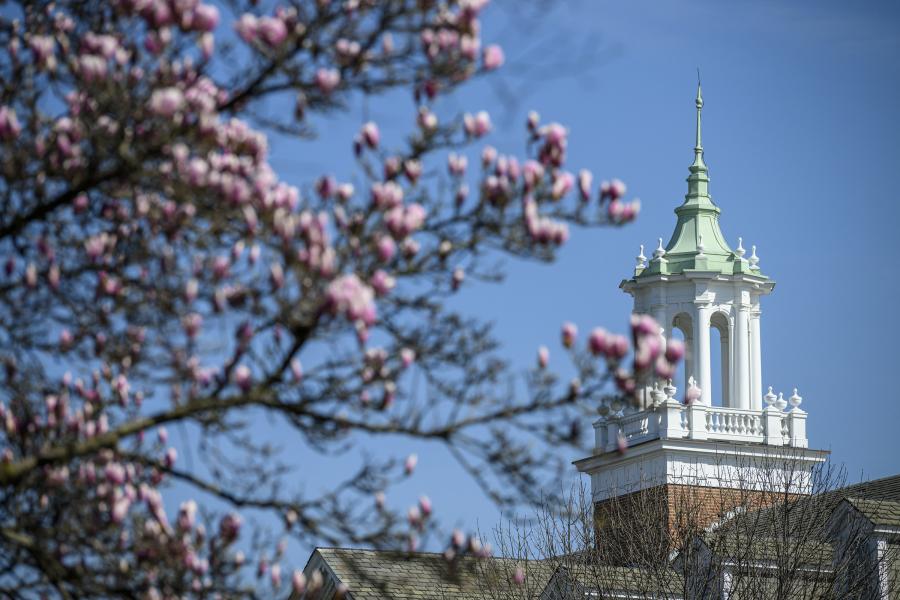
Question: Is it true that
Daniel Coit Gilman's
will required that no building should rise higher than the
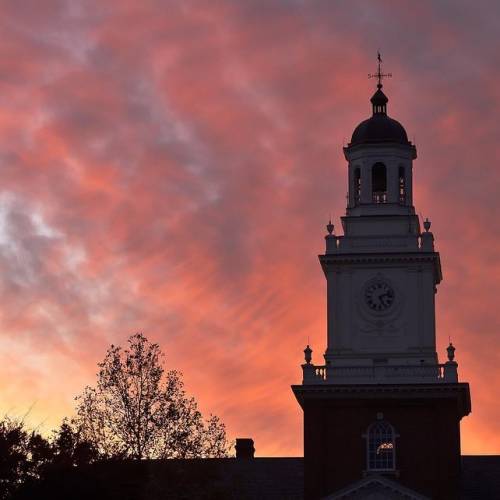
Gilman Hall clock
tower, or that the clock tower should not be blocked from
view of Charles
Street?
Answer: There is no truth
to either statement.
Gilman retired from Hopkins in 1901 and died in 1908. He left
no money to
the University, nor did he leave any stipulations as to
future construction
on the campus. Gilman Hall, constructed between 1913 and
1915, was named for
him to recognize his 25 years service as Hopkins' founding
president. The
reason the MSE Library was constructed primarily underground
is that a building
of such size, built above ground, would have dwarfed Homewood
House and neighboring
classroom buildings. Homewood House, with its Federal style
of architecture,
served as the model for subsequent campus buildings.
Question: What are the
names of Hopkins'
past presidents and when did they serve?
Answer:
- Daniel Coit Gilman / May 1875 - August 1901
- Ira Remsen / September 1901 - January 1913
- Frank Johnson Goodnow / October 1914 - June 1929
- Joseph Sweetman Ames / July 1929 - June 1935
- Isaiah Bowman / July 1935 - December 1948
- Detlev Wulf Bronk / January 1949 - August 1953
- Lowell Jacob Reed / September 1953 - June 1956
- Milton Stover Eisenhower / July 1956 - June 1967
- Lincoln Gordon / July 1967 - March 1971
- M. S. Eisenhower / April 1971 - January 1972
- Steven Muller / February 1972 - June 1990
- William Chase Richardson / July 1990 - July 1995
- Daniel Nathans (interim) / June 1995 - July
1996
- William R.
Brody / August
1996 - present
Question: Who was the first
woman to receive
a degree from Johns Hopkins?
Answer: This question
requires a two-part
answer. The first woman to earn the PhD was
Christine Ladd-Franklin,
who completed her studies in 1882. The trustees refused to
grant her the degree
until 1926, however. In the meantime, Florence Bascom earned
and received
her PhD in 1893.
Question: Who was the first
African-American
to attend Hopkins?
Answer: Kelly Miller was
admitted as a
graduate student in mathematics in 1887. He studied for two
years before leaving,
without a degree, in 1889. He subsequently earned degrees
from Howard University
and became a prominent educator and advocate of education for
African-American
children.
Question: What is the
official Hopkins motto?
Answer: "Veritas vos
liberabit." "The
truth shall make you free." Quoted from John 8:32.
Question: What are the
official Hopkins
colors?
Answer: The university's
official colors
are gold and sable. Its athletic colors are Columbia blue and
black.
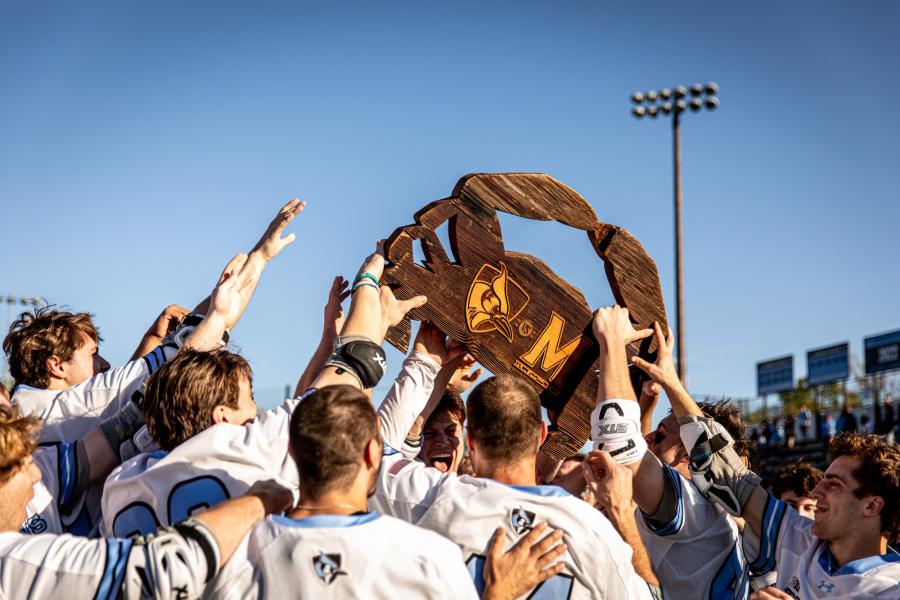
Question: Why are the Johns
Hopkins University athletic teams called the "Blue Jays"?
Answer:
At first, the Johns Hopkins athletic teams were called simply
"the Black and Blue," based on the university's athletic colors.
Then, in 1920, some undergraduates launched
a student humor magazine called The Black and Blue Jay.
The "black and blue" came from the colors, of course, and the
"Jay" most likely came from the "J" in Johns Hopkins.
The student humor magazine became popular and began
being quoted nationally in such publications as College
Humor and The Literary Digest. In the spring of
1922, the News-Letter occasionally began to refer
to Hopkins athletes as "Blue Jays," most likely because
some of the editors of The Black and Blue Jay and the
News-Letter worked on both publications. The
nickname didn't immediately become the standard
reference for several years. Both the News-Letter and other
newspapers — such as The Sun and The
Washington Post still referred to Hopkins athletes as
"the Black and Blue" well into the 1920s. Sometimes they also
referred to Hopkins players as the Blue Jays — and
eventually, the Blue Jays became the favored name.
The majority of these Q&As were provided by James Stimpert, Johns Hopkins University Archives, stimpert@jhu.edu. Anyone desiring further information on Hopkins history may contact the Archives.
The mission of The Johns Hopkins University is to educate its students and cultivate their capacity for life-long learning, to foster independent and original research, and to bring the benefits of discovery to the world.